Mainstream payment apps know exactly who you pay, when, and for how much. Cash App, Venmo, PayPal, and WeChat built their convenience on that visibility, holding your balance and logging every transfer as a condition of use.
Radar, a new messenger from the team behind Cake Wallet, is a bet that you can move money to the people you already talk to without handing any one company that full record.
“Apps like PayPal and Cash App made sending money easier, but they’re centralized services,” said Vikrant Sharma, who founded Cake Wallet and serves as chief executive of both firms. “They hold your money, they can freeze your account, and they see every transaction you make. Convenience came at the cost of control.”
Radar launched on July 7 for iOS, with an Android APK available now and a Google Play release still to come. It runs on Signal’s open-source protocol and network, so the encrypted messaging people already rely on carries over intact.
You log into an existing Signal account inside Radar, and your contacts, chats, groups, and username all follow. The addition fits right beside the message box, a Bitcoin button that turns a conversation into a way to pay. You tap it, enter an amount, and the sats land in the thread.
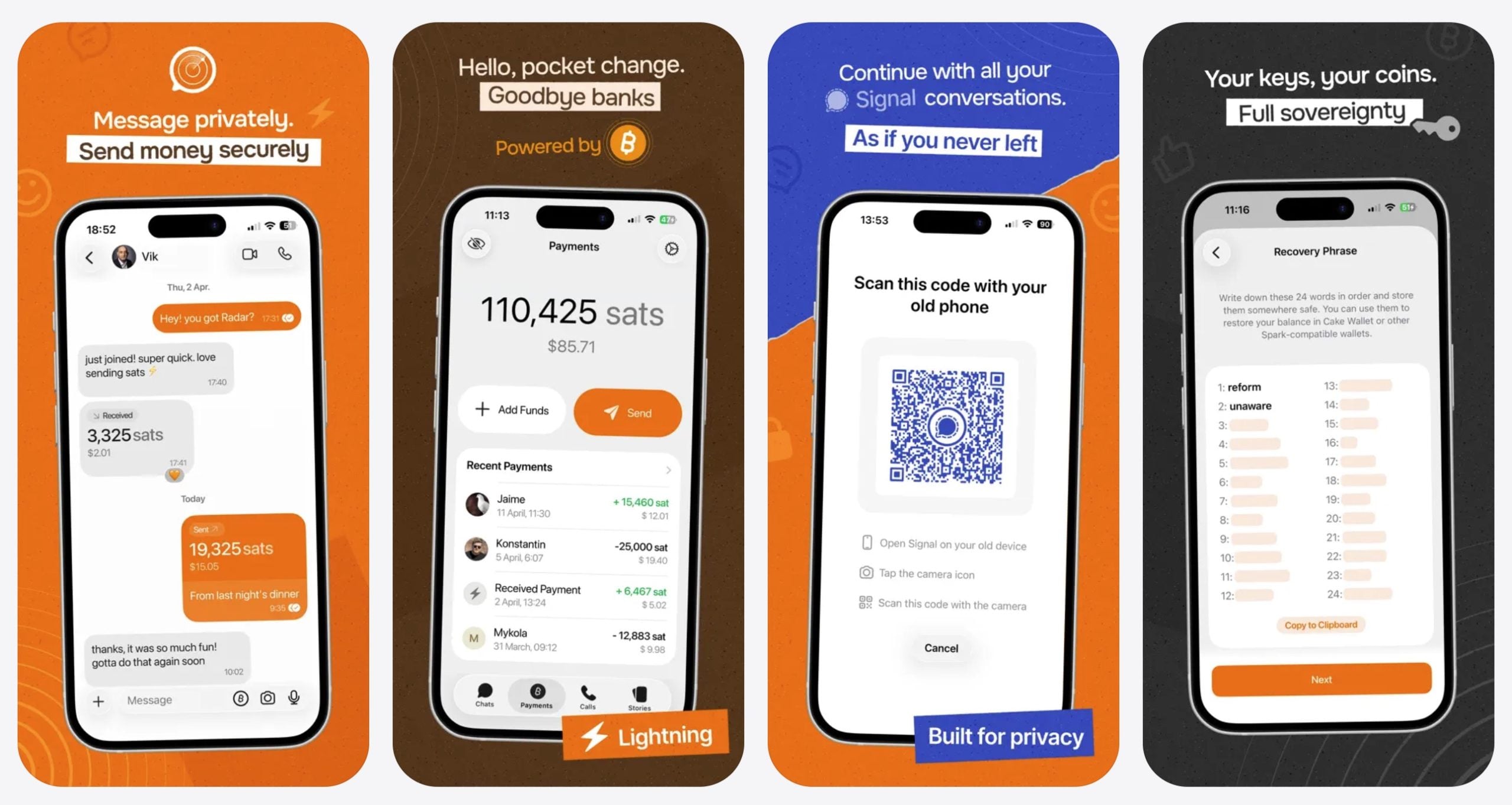
“The idea behind Radar is that the people we talk to and the people we pay are often the same people, yet messaging and payments still live in separate places,” Sharma said.
The payments run on Spark, a Bitcoin layer-2 network, using the Breez SDK to handle the wiring. Transfers between two Radar users clear Spark to Spark in under a second, and because they settle that way, a recipient can be offline and still collect them.
Radar speaks Lightning too, so you can pay any outside Lightning wallet or refill your balance from one. Accounts come with a Lightning address you can rename, and funds stay in your custody behind a standard twelve-word seed phrase.
By default, Radar encrypts your keys into your Signal account, which lets a newcomer who never writes down a seed phrase still recover their money. That convenience carries a familiar cost, though. Whoever holds your phone number and Signal PIN holds the road to your funds, which is why the company treats the Signal backup as a floor and the seed phrase as the real safeguard for anything past spending cash.
The privacy design rests on cutting up knowledge so no party sees the whole transaction. Radar says it gathers nothing, no analytics on who you are or what you send. Signal hosts the messaging, so it sees your phone number and username, yet it reads payments only as ordinary encrypted messages, with no way to tell they carry money. Spark clears the value of a transfer without ever learning your phone number or Signal identity. That’s three parties, three partial views, and no single ledger tying your chats to your coins.
Those seams hold only while the three stay separate, and the phone number that Signal still demands for spam control remains the one identifier threaded through everything. Radar’s answer is that this beats the arrangement it replaces, where a lone custodian watches every message and every payment side by side.
Sharma said Radar has tested payments up to $5,000, with the ceiling set by Lightning liquidity rather than any cap in the app. There is no technical maximum on what you can hold, though the company is direct that this is hot-wallet territory. Keys live on a phone, so real savings belong on hardware kept elsewhere.
Radar takes no cut today. The only costs are Spark network fees, roughly two sats per transfer, plus whatever Lightning routing runs on an outside payment. Revenue is meant to arrive later, when the app lets newcomers top up with a debit card, credit card, Apple Pay, or Google Pay, the kind of on-ramp that reaches people who never held Bitcoin.
There’s something else to consider, though. The whole model leans on Signal, tolerating an outside client on its servers. Signal’s code is open, yet the Foundation controls who reaches its infrastructure and could block Radar’s users by their client signatures if it wanted to.
Seth For Privacy, Radar’s chief operating officer, has said such a move is possible while adding that he hopes it never comes. Radar has begun donating to the Signal Foundation every month and plans to raise those payments as it grows. A client called Molly has used the Signal network for years without trouble, which the team treats as precedent.
Cake Wallet grew with no venture money after Sharma started it in 2018. Radar is taking the other road as a separate company with shared leadership, backed by Ego Death Capital as its first investor and in talks with a few more.
Whether people will accept a phone number welded to a messenger as the price of holding their own keys is the question Radar now gets to answer.