
In January 2026, the Federal Trade Commission plans to gather a small army of “experts” in Washington to discuss a topic that sounds technical but reads like a blueprint for a new kind of internet.
Officially, the event is about protecting children. Unofficially, it’s about identifying everyone.
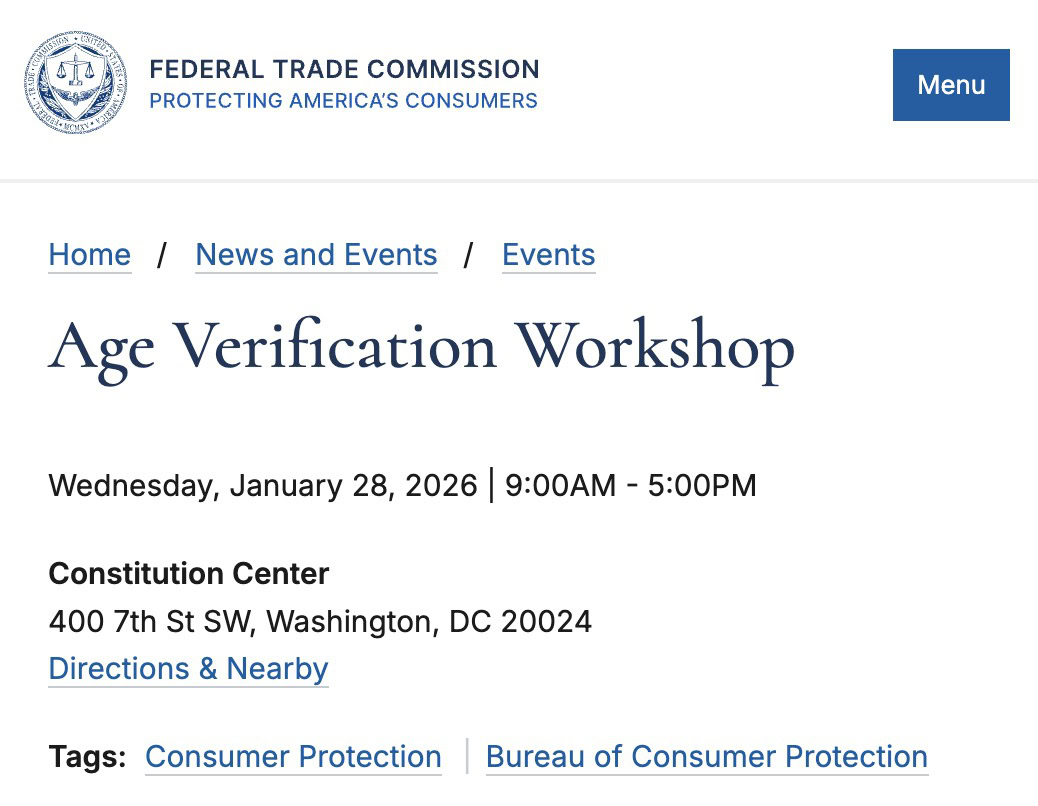
The FTC says the January 28 workshop at the Constitution Center will bring together researchers, policy officials, tech companies, and “consumer representatives” to explore the role of age verification and its relationship to the Children’s Online Privacy Protection Act, or COPPA.
It’s all about collecting and verifying age information, developing technical systems for estimation, and scaling those systems across digital environments.
In government language, that means building tools that could determine who you are before you click anything.
The FTC suggests this is about safeguarding minors. But once these systems exist, they rarely stop where they start. The design of a universal age-verification network could reach far beyond child safety, extending into how all users identify themselves across websites, platforms, and services.
The agency’s agenda suggests a framework for what could become a credential-based web. If a website has to verify your age, it must verify you. And once verified, your information doesn’t evaporate after you log out. It’s stored somewhere, connected to something, waiting for the next access request.
The federal effort comes after a wave of state-level enthusiasm for the same idea. Texas, Utah, Missouri, Virginia, and Ohio have each passed laws forcing websites to check the ages of users, often borrowing language directly from the European Union, Australia, and the United Kingdom. Those rules require identity documents, biometric scans, or certified third parties that act as digital hall monitors.
In these states, “click to enter” has turned into “show your papers.”
Many sites now require proof of age, while others test-drive digital ID programs linking personal credentials to online activity.
The result is a slow creep toward a system where logging into a website looks a lot like crossing a border.
This rush to verify everyone’s age destroys the privacy that once defined the web. If every click depends on presenting government-issued ID or biometric data, anonymity disappears. The internet begins to resemble a network of checkpoints, where access to information depends on identity verification.
The bigger risk is the infrastructure built to hold it. Systems capable of verifying identities at scale are also systems capable of tracking behavior. Once governments or companies build massive databases of verified users, the temptation to use them for other purposes grows quickly.
By organizing this workshop, the FTC signals it’s ready to explore embedding verification into the broader web ecosystem.