
Turkey is moving to make anonymous VPN use illegal, and Proton VPN signups in the country have doubled as word spreads. The Turkish government’s plan, reported by local outlet Yeni Şafak, would outlaw unlicensed VPN services and require any approved provider to log what users do and turn those records over to Turkish authorities on request.
A VPN that logs and reports isn’t really a VPN. It’s a second surveillance pipe pointed at the same people the government already watches.
Officials describe the measures as part of a package aimed at protecting children after school attacks in Şanlıurfa and Kahramanmaraş, with attackers reportedly drawn to violent mobile games. Packaged alongside the VPN clampdown are parent-controlled “child SIM” lines and a cap on how many mobile numbers a single person can register.
The child-protection wrapper is the sweetener, because the actual infrastructure being built, licensed VPN providers that log and disclose, reaches every adult in the country, not just children playing shooters on their phones.
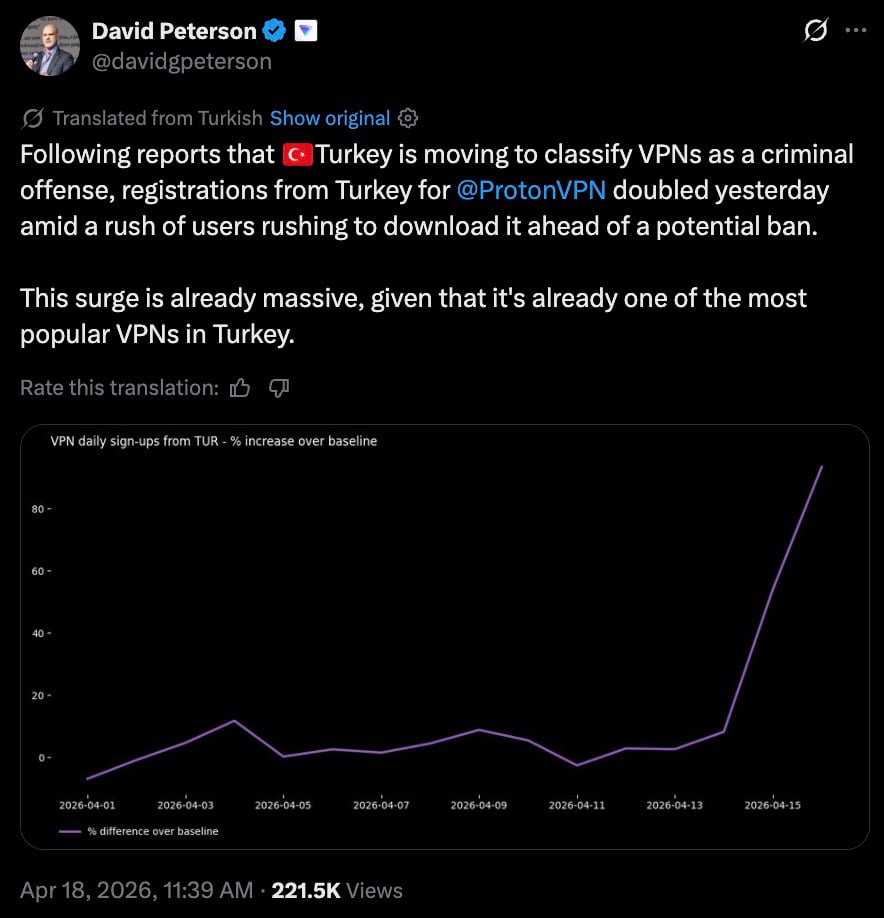
Proton VPN General Manager David Peterson confirmed the signup spike and said the company is seeing connection blocks too, particularly on Vodafone. His guidance to Turkish users was practical rather than political.
Turn on Proton’s Stealth protocol, which disguises VPN traffic as ordinary internet traffic so it slips past filters. Switch on Alternative Routing, which reroutes connections when the usual paths are blocked. If the Proton VPN website itself is unreachable, the Android and iOS apps remain available through Google Play and the App Store, and the clients are also hosted on GitHub.
None of this is new territory for Turkey. The country has a history of internet shutdowns and targeted blocks, and Proton VPN has been one of 27 providers whose websites are already restricted there. In August 2024, Turkish ISPs moved against a raft of VPN providers and Proton recorded a 4,500% spike in signups.
Last March, after the arrest of Istanbul Mayor Ekrem İmamoğlu and the throttling of major social platforms, signups jumped 1,100% over baseline. Vodafone Turkey, which controls roughly a third of the country’s mobile internet, has shown up repeatedly in these episodes, with Proton tracing past outages to carrier-level DNS manipulation rather than genuine technical faults.
What the licensing proposal would add is a legal ceiling on escape. Right now, Turkish users can route around blocks with an unapproved VPN and keep their browsing off the state’s books. A licensing regime closes that door by design. The only VPNs left standing would be the ones that agreed to keep records and hand them over. Anyone using something unlicensed would be breaking the law. The same population that turned to VPNs for anonymity would find that anonymity is criminalized.
The privacy cost lands in two places. The first is obvious. Approved VPNs that log become a searchable history of what every Turkish user did online, who they talked to, what they read, and where they routed their traffic from.
Second, once a licensing regime exists, the government gets to decide which providers qualify, and providers that refuse to log are simply excluded from the market. The infrastructure that results is a permission system with authorities holding the clipboard.
Peterson’s practical advice, install before you need it, use Stealth, route around blocks, sits in the gap this legislation is trying to close. Proton’s pitch is that a VPN that doesn’t log is the whole point of a VPN, and that circumvention tools will keep working whether or not a government licenses them.
Turkey’s pitch is the opposite. Approved means logged. Unapproved means illegal. There is no third option being offered, which is usually the cue to ask why the option that protects users most is the one being removed.