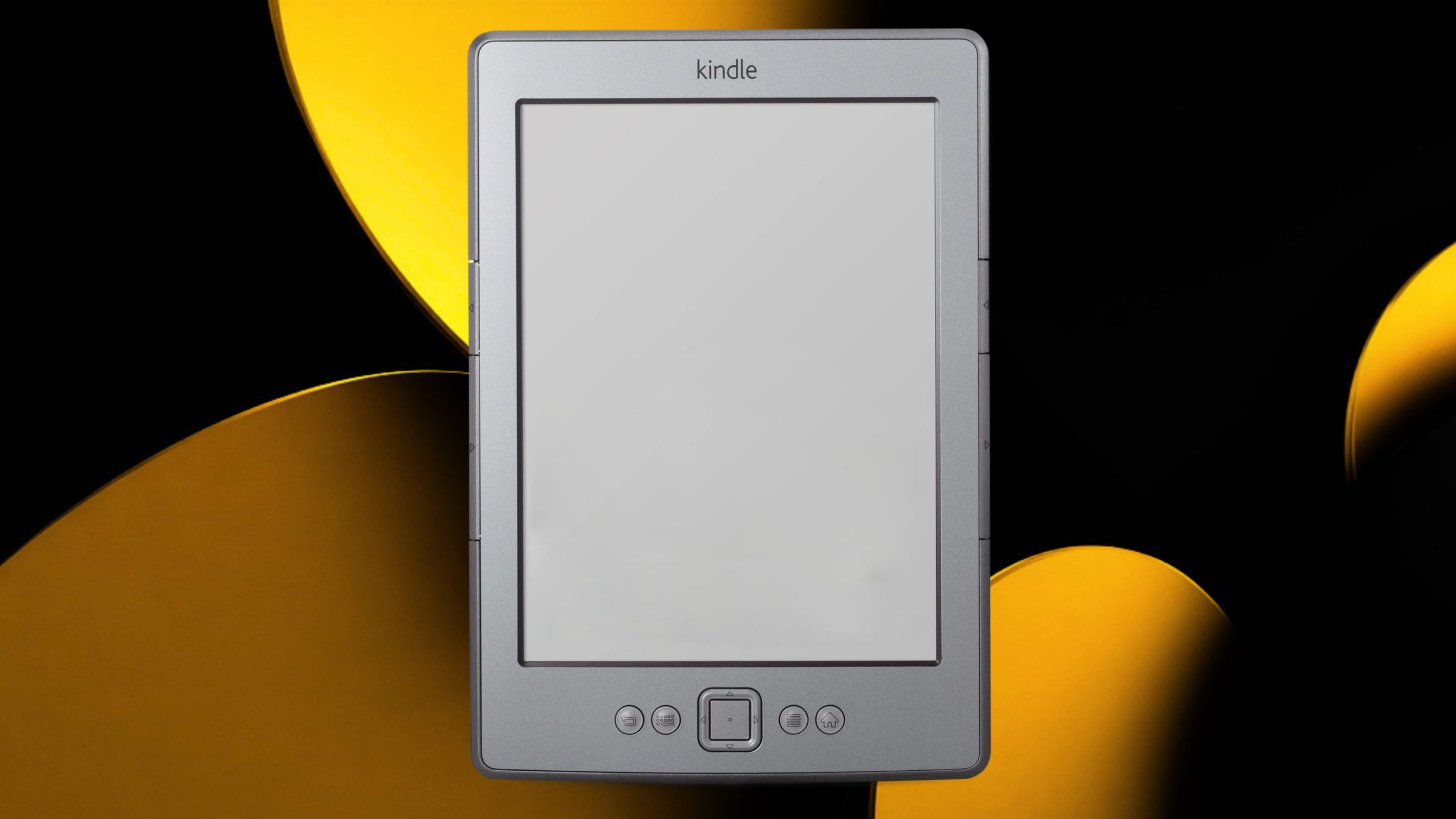
A record player from 1972 still plays records. A paperback from 1985 still opens. A Kindle from 2011, the one that works perfectly, the one with no cracked screen or dead battery, will stop functioning as an e-reader on May 20, 2026, because Amazon decided it should.
Amazon sent emails this week to owners of Kindle devices manufactured in 2012 or earlier, informing them that support for their hardware would end in six weeks.
After May 20, those devices will no longer be able to buy, borrow, or download books. The only content available will be whatever is already sitting on the device. And if you factory reset your Kindle, or deregister it from your Amazon account for any reason, you will not be able to re-register it. At that point, the device becomes a plastic rectangle.
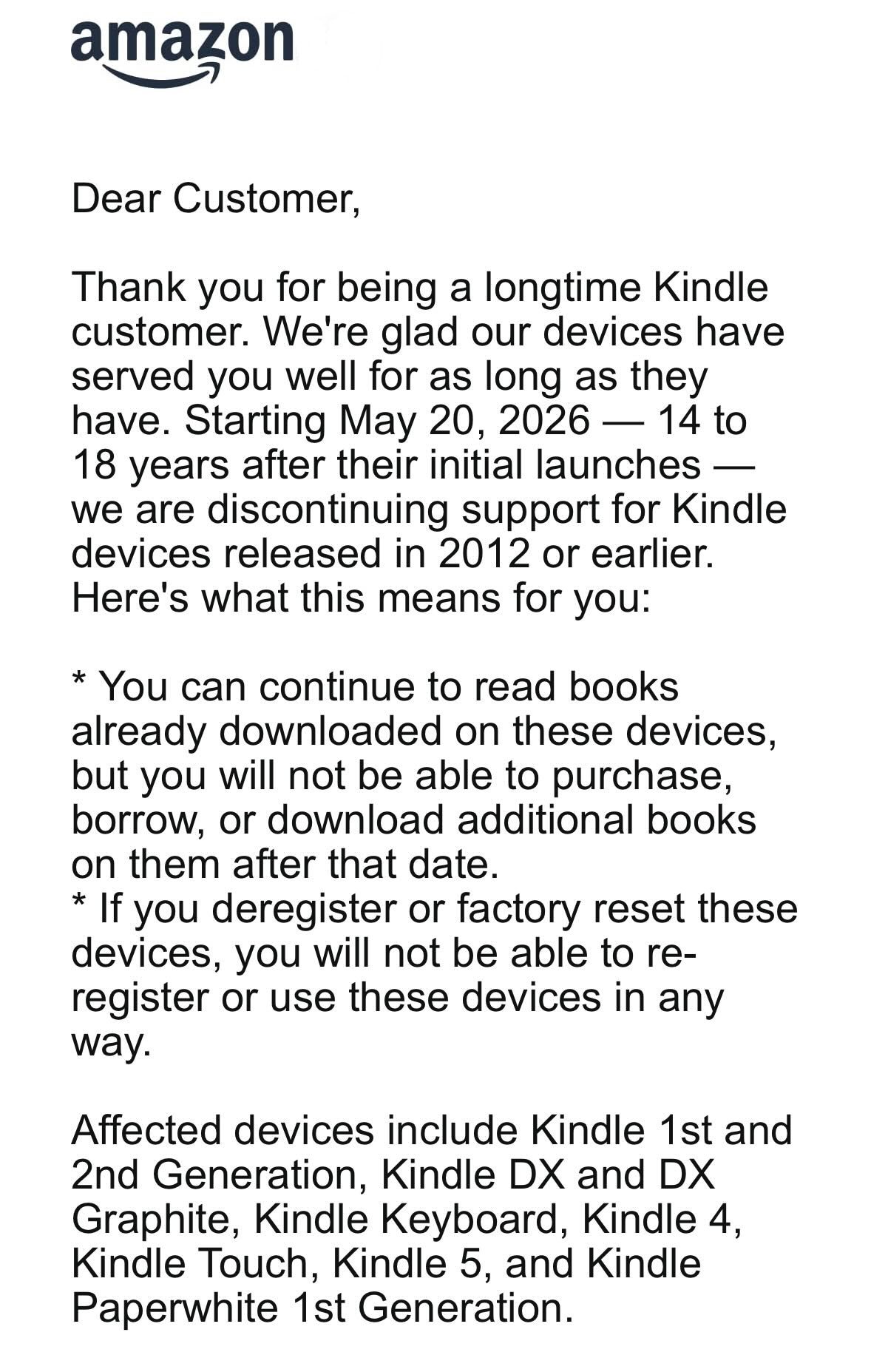
The affected models include the original Kindle, Kindle 2, Kindle DX, Kindle Keyboard, Kindle 4, Kindle 5, Kindle Touch, and the first-generation Kindle Paperwhite. Some of these devices have been in continuous use for 14 years. They work. The screens display text. The batteries hold a charge. The page-turn buttons click. None of that matters.
Amazon spokesperson Jesse Carr said that, “These models have been supported for at least 14 years — some as long as 18 years — but technology has come a long way in that time, and these devices will no longer be supported moving forward.” He added that Amazon is “notifying those still actively using them and offering promotions to help with the transition to newer devices.”
The promotion is a 20 percent discount on a new Kindle and a $20 eBook credit. Amazon is offering customers a coupon to buy something they didn’t want to buy, to replace something that already works. The offer expires June 20, 2026, which gives affected users exactly one month to decide whether to spend money solving a problem Amazon created for them.
The deregistration clause is where this gets ugly. The email Amazon sent includes a specific warning: if you deregister or factory reset your device after May 20, you cannot re-register it. The device becomes permanently unusable as a Kindle.
Here’s what that means.. Your Kindle glitches. You need to reboot it. The reboot requires a factory reset. Your Kindle is now a brick. You bought it, you paid for it, you’ve used it for over a decade, and now it’s garbage because a software handshake with Amazon’s servers failed, and there’s no way to reconnect.
A Reddit user in r/mildlyinfuriating put it plainly: “I’ve had my Kindle for years, but it still works perfectly and continues to serve me well. How wasteful is it to make a product practically unusable in order to force people to buy a newer model.”
Amazon controls 72 percent of the global e-reader market. In the United States, the company handles 67 percent of all digital book sales, rising to 83 percent when Kindle Unlimited is included.
When Amazon decides your reading device is obsolete, you don’t have a lot of alternatives within the ecosystem you’ve been buying into for years. Your library, your purchases, your reading history, all of it lives on Amazon’s servers. You can access your books through the Kindle app on your phone or through Kindle for Web, Amazon says, but the device you bought to read books on can no longer read new books. The hardware is fine but the software permission has been revoked.
This keeps happening, and the pattern is always the same.
In April 2025, Google announced it would end support for its first and second-generation Nest Learning Thermostats. Starting October 25, 2025, those devices lost the ability to connect to the Google Home app, receive remote commands, or get software updates. A thermostat that was sold as a smart device became a dumb one overnight. The hardware worked. Google just stopped talking to it.
Google offered affected US customers a 50 percent discount on the fourth-generation Nest thermostat, which costs $280 at retail. Same formula as Amazon. We broke your thing, here’s a coupon for a new thing.
A class action lawsuit was filed, alleging Google had deprived consumers of features they’d already paid for. The lawsuit contends that customers would not have purchased the thermostat, or would have paid less, if they’d known Google could strip away core functionality on a corporate whim.
The thermostats still work as basic temperature controllers. You can still walk up to the wall and press buttons. But nobody paid $250 for a device that lets you walk up to a wall and press buttons. They paid for the app, the scheduling, the remote control, the energy savings from smart algorithms. All of that disappeared on a date Google chose.
In 2019, Sonos launched a trade-up program that required customers to put their older speakers into something called Recycle Mode. Once activated, a 21-day countdown began, after which the speaker was permanently bricked. Sonos offered a 30 percent discount on newer speakers in exchange for customers voluntarily destroying working hardware. After public backlash, the company reversed course in March 2020 and stopped requiring the bricking. But speakers that had already been put into Recycle Mode stayed bricked. Those devices were gone.
In 2022, Insteon, a smart home company, abruptly shut down its cloud servers without warning. Thousands of users woke up to find their smart home hubs offline. Lights, thermostats, door locks, all controlled through Insteon’s servers, all suddenly unresponsive. The hardware was fine. The company just stopped existing in the way that mattered.
Lowe’s did the same thing in 2019 when it shut down its Iris smart home platform. CNET described the resulting hardware as “expensive bricks.”
Reading is not a complicated activity. A book is a self-contained object. You buy it, you own it, you read it whenever you want, and nobody can remotely disable it. The same is true of a record player, a CD player, and a cassette deck. These are devices that perform their function without asking permission from a server.
The Kindle changed that relationship. The Kindle is a reading device that requires ongoing permission from Amazon to perform its basic function. The permission can be revoked. And while Amazon frames this as a natural consequence of technological progress, there’s nothing natural about it. The decision was made in a meeting. It was a business choice.
The broader lesson here extends well beyond e-readers. Every internet-connected device in your home carries the same risk. The smart fridge that connects to an app for grocery lists. The smart washing machine that lets you start a cycle from your phone, the smart oven, the smart doorbell, the smart light bulbs; all of them depend on servers maintained by companies that may decide, at any point, that your model is no longer worth supporting.
When that happens, you have an appliance that was broken for you. The motor in the washing machine still turns and the thermostat still measures temperature. But the software layer that was sold as the reason to buy these products gets switched off, and the company offers you 20 percent off their new model.
A non-smart washing machine from 2005 still washes clothes. A non-smart thermostat from the 1970s still controls temperature. A paperback from any year still opens to the page you left off on. These objects do what they were made to do because their function is contained within them, not outsourced to a server farm that someone else controls.
The Kindle was supposed to make reading more convenient. For millions of people, it did, and still does. But the trade-off was always there, buried in the terms of service: you are reading with permission, and the permission can be revoked with six weeks’ notice and a coupon.
Amazon reported roughly $28 billion in annual book sales worldwide. The company’s Kindle ecosystem is valued at approximately $18 billion.
This is not a company that cannot afford to maintain server compatibility for older devices. This is a company that chose not to. The 20 percent discount makes the motive clear enough. Amazon wants these customers to buy new Kindles. The support cutoff is the mechanism that makes it happen.
The oldest affected Kindle was released in 2007. If you bought one of those, you’ve been an Amazon customer for 19 years. Amazon’s reward for that loyalty is an email telling you to buy a new one, with a discount that expires in a month.