

The dreaded day has arrived. Discord CTO Stanislav Vishnevskiy announced on Tuesday that every account on the platform will from now on be assigned one of three age groups - adult, teen, or unconfirmed - and that this is determined automatically by the system.
The announcement comes a day before the change takes effect, on September 23, and the post says the signals that decide the group an account belongs to are "how long your account has existed or the kinds of servers you're a part of" - and, Discord claims, "we don't look at your messages, calls, or other content." In other words, users will be more closely surveilled.
According to Vishnevskiy, users will be able to see which group they belong to by going to User Settings > Account Status, and while he says that "more than 90% of you won't be asked to confirm your age," it's clear that the rest will have to go through some form of verification.
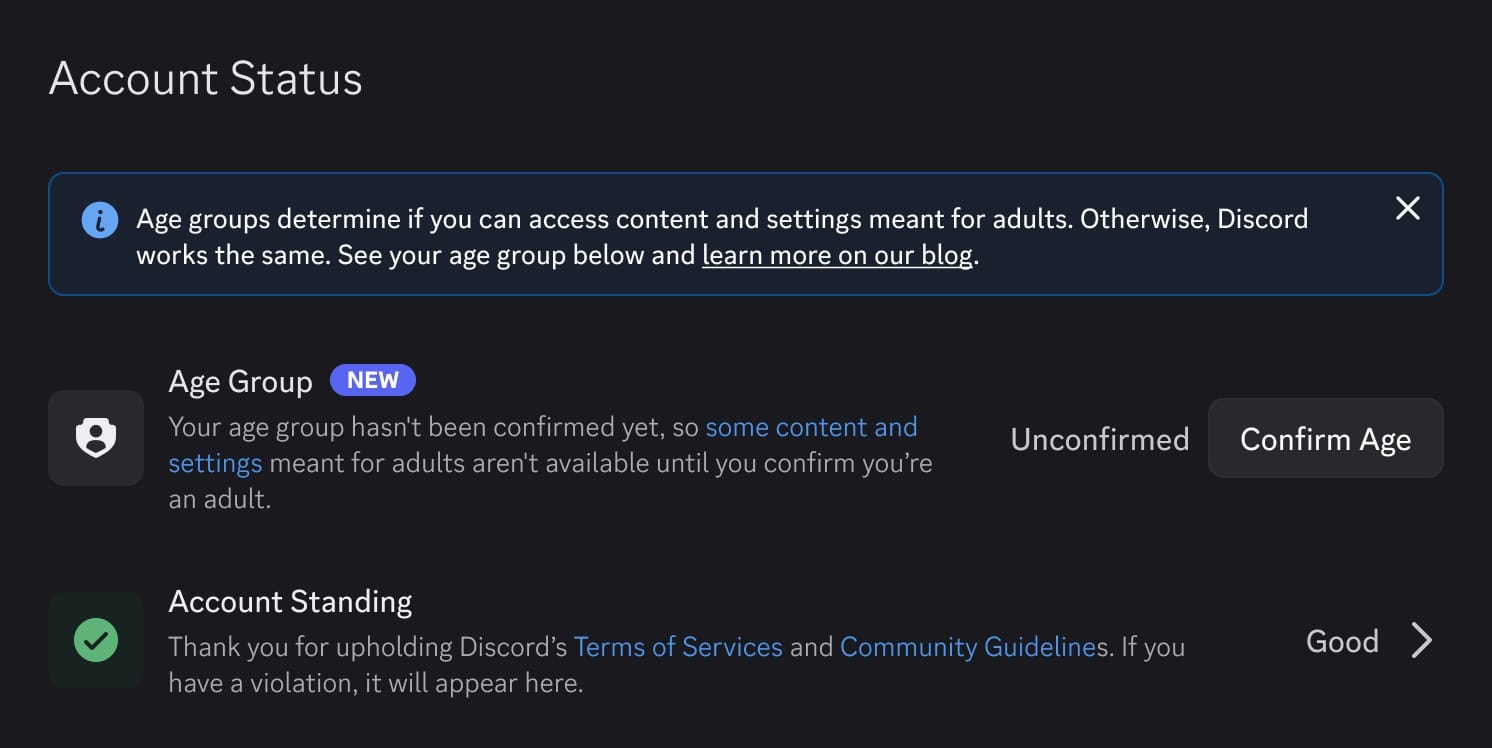
Discord has in the past said it has more than 200 million monthly active users, so if 90% are not asked to verify, that still means that more than 20 million will have to.
Vishnevskiy framed this as a positive thing, saying, "If you're in the adult age group (18+), nothing changes."
But for those who are put into the "teen" group, a number of restrictions kick in, and those in the "unconfirmed" group will have it almost as bad, with the difference being that their activity and profile will be visible to every server they are a part of.
Those in the "teen" group will have sensitive images and video blocked or blurred, and will not be able to reach age-restricted channels and servers. They will also not be able to use age-restricted bot commands, and direct messages from non-friends will go into the Message Requests inbox, which will have spam filtering turned on by default to filter everything.
Teen accounts will not be able to speak in Stage channels, and their activity and full profile will be visible only to friends and small servers.
Those in the "unconfirmed" group will have the same restrictions, except that their activity and profile will be visible to all servers they are a part of.
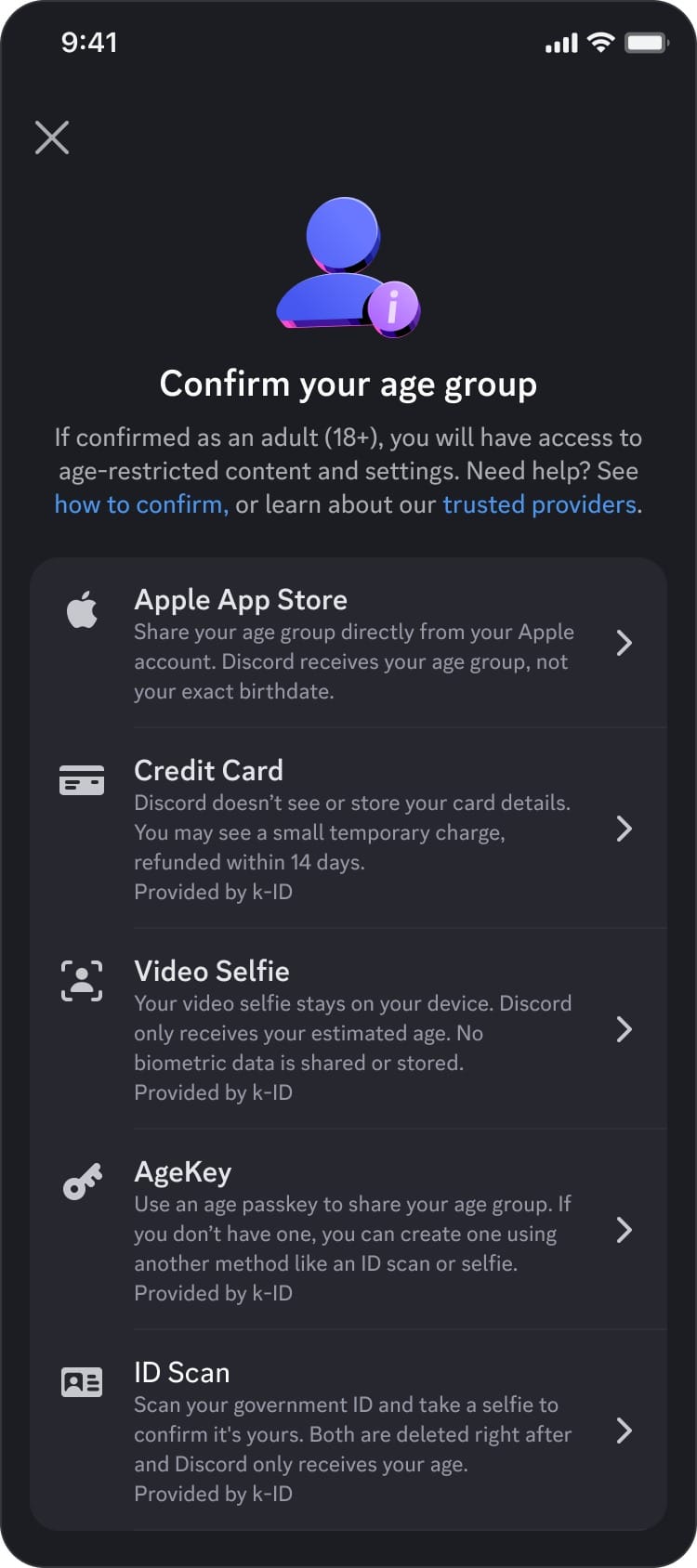
As for how an adult who is wrongly classified as a minor can get out of this, the instructions are to go to Account Settings and follow the prompts to "appeal" the decision. This can be done by scanning an ID and taking a selfie, using a credit card, receiving an age signal from an app store, using a passport-based credential in Google Wallet (only in Brazil, Singapore, Taiwan, the UK and the US), or using a reusable AgeKey credential.
Another option is to use a video selfie that stays on the device and only sends an estimated age to Discord.
Those who choose to scan their ID and take a selfie will be sending this data to a third-party vendor, and the same is true of those who choose to use a credit card for verification. The selfie and ID scan go to Veratad, while the credit card check is run by Stripe.
Discord says that this vendor, k-ID, is "vetted" and that it has "fully retired the previous manual review process with a customer service vendor that led to the September 2025 data breach" and that this process "no longer exists."
The company also promises that it will only receive information about a user's age group and no personal data beyond that, and that vendors are "required to delete your uploaded data immediately after confirming your age group."
But the September 2025 breach that exposed more than 70,000 government IDs happened precisely during the manual review of age verification, carried out by a third-party support vendor, and this is something Discord says is now gone - but it is not clear how the company can guarantee that another vendor, k-ID, will not suffer the same fate.
And even if it does not, the promise of deletion of data after verification is one that has been made and broken before, notably by the women's dating-safety app Tea, which told users that their ID scans and selfies were deleted after verification, but then left them exposed on the internet.
In France, the age verification provider AgeGo promised "double anonymity" to those using it to access adult content, but was found to be storing logs of those visiting the sites, despite the promise that the company would not know which sites a user visited.