California Governor Gavin Newsom, who has in the past turned a blind eye to online censorship, has said he’s investigating whether TikTok is violating state law by suppressing political content critical of President Donald Trump.
The governor said Monday that he is directing state officials to review whether the platform engaged in viewpoint-based moderation after reports that certain posts were hidden or received zero engagement.
“It’s time to investigate. I am launching a review into whether TikTok is violating state law by censoring Trump-critical content,” Newsom wrote on X.
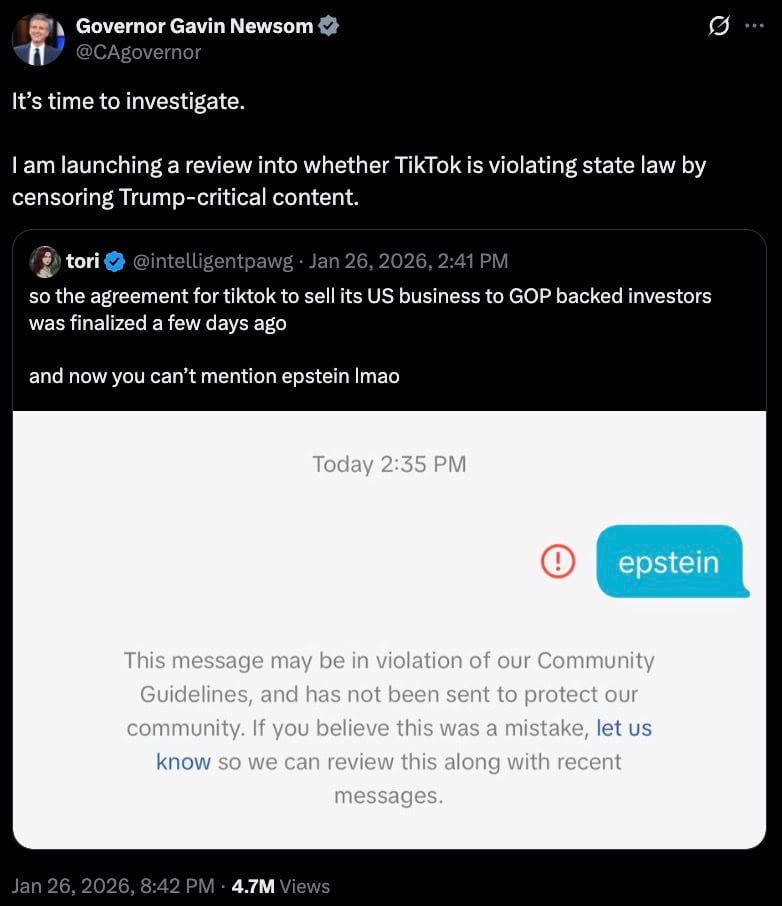
His office later said it had “independently confirmed instances of suppressed content critical of President Trump” and would refer the matter to the California Department of Justice for further examination.
The inquiry follows a wave of user reports showing apparent restrictions on videos mentioning Trump, the immigration agency ICE, or the fatal shooting of nurse Alex Pretti in Minneapolis.
Some users also said they were unable to send direct messages containing the word “Epstein,” referring to Jeffrey Epstein, the convicted child sex offender. Screenshots circulated online appeared to show those messages blocked for “potential guideline violations.”
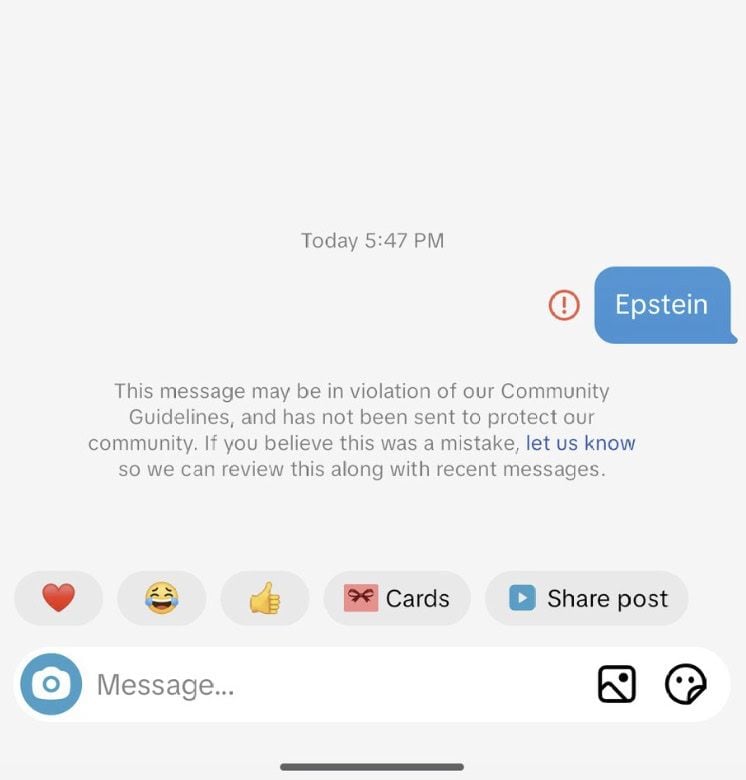
TikTok denies any deliberate censorship. The company said it is investigating the “Epstein” issue, but maintains that no policy bans the name. “We don’t have rules against sharing the name ‘Epstein’ in direct messages and are investigating why some users are experiencing issues,” a TikTok representative said.
TikTok also attributed the recent wave of technical disruptions to a power failure at one of its US data centers, which caused its algorithm to fail. “It would be inaccurate to report that this is anything but the technical issues we’ve transparently confirmed,” a company spokesperson said.
The outage reportedly triggered a system-wide failure that left some videos stuck at zero views and slowed load times for many users.
“Over the weekend, an Oracle data center experienced a temporary weather-related power outage which impacted TikTok,” an Oracle spokesperson said.
A winter storm did strike large parts of the US over the weekend.
“The challenges US TikTok users may be experiencing are the result of technical issues that followed the power outage, which Oracle and TikTok are working to quickly resolve.”
The controversy comes shortly after TikTok’s US division underwent a major restructuring designed to prevent a national ban. Under the deal, a consortium of American investors, including Oracle, acquired control of US operations.
Oracle’s co-founder, Larry Ellison, a close Trump ally, now oversees the handling of US user data.
California State Senator Scott Wiener said he experienced unexplained suppression on his own account, suggesting that it was politically motivated.
A video he posted criticizing ICE and referencing the Minneapolis shooting of Alex Pretti received no engagement at all. “Clearly, TikTok is suppressing criticisms of ICE,” he said, noting that his other posts have never performed that poorly.
While the low reach and algorithmic chaos affected TikTok more broadly, the political videos are what has received most attention.
Only after the investigation was announced did attention return to Newsom’s own record on speech regulation. As governor, he has signed several bills expanding state authority over digital content, including measures aimed at “misinformation” on social-media platforms.
He also suggested that California’s censorship statutes could be applied to AI-generated parody videos of public officials. Those earlier positions have drawn concern from free-speech advocates who argue that such laws give the government too much influence over what can be said online.
Whether the TikTok suppression reports reflect deliberate censorship, technical failure, or political convenience, the case illustrates how fragile open communication becomes when both governments and corporations wield power over online discourse.
For users, the distinction may not matter. A message that fails to send because of a glitch is indistinguishable from one that disappears for political reasons. And when one of the arguments about American companies taking over TikTok was due to the potential for China to censor.
Once a handful of private systems determine whose words circulate and whose do not, even accidental silence starts to look like policy.