

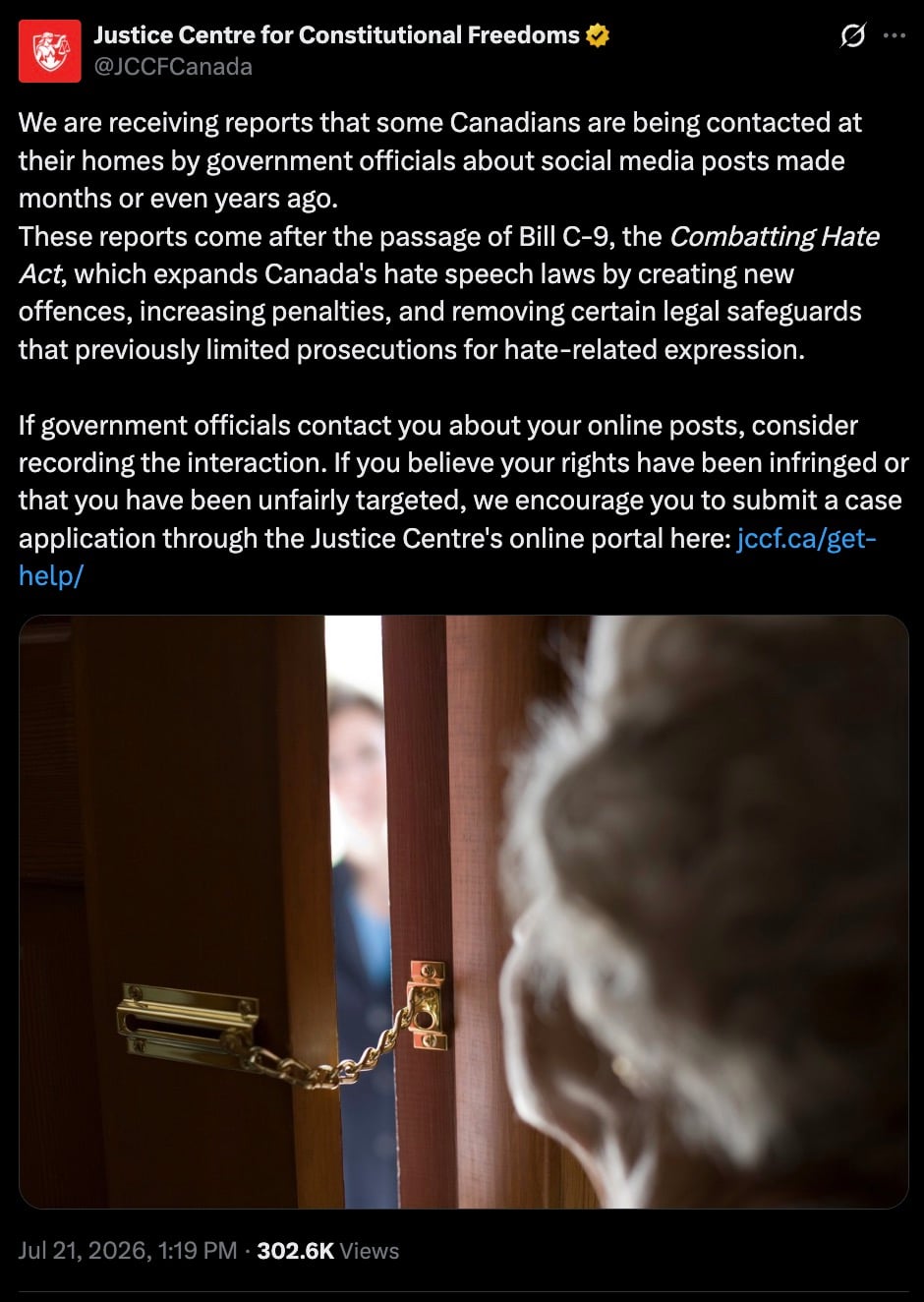
Government officials in Canada are contacting people at their homes over social media posts written months or years ago, according to the Justice Centre for Constitutional Freedoms (JCCF).
The legal advocacy group says the reports began arriving after Bill C-9, the Combatting Hate Act, cleared Parliament. The law received royal assent on June 18 and came into force on July 18, expanding Canada’s “hate speech” offenses, raising penalties, and eliminating defenses that had limited prosecutions for what the state calls hate-related expression.
“We are receiving reports that some Canadians are being contacted at their homes by government officials about social media posts made months or even years ago,” the JCCF wrote. “These reports come after the passage of Bill C-9, the Combatting Hate Act, which expands Canada’s hate speech laws by creating new offences, increasing penalties, and removing certain legal safeguards that previously limited prosecutions for hate-related expression.”
The Act makes hate-motivated crime a standalone offense and creates new charges for intimidating or obstructing people at places of worship, schools, and community centers. It also criminalizes the public display of symbols used by listed terrorist groups, two Nazi symbols, and a noose.
Maximum sentences climb across the board.
The JCCF’s reading of the bill puts the increases at two years to five for lesser offenses, five to ten for the next tier, and up to life imprisonment for the most serious hate-motivated crimes.
The law defines hatred as “an emotion of an intense and extreme nature that is clearly associated with vilification and detestation.” Police and prosecutors decide which posts meet that description.
Bill C-9 also removes the good-faith defense that had shielded religious opinion under the Criminal Code, which let a person avoid conviction for expressing, in good faith, an opinion on a religious subject or an opinion based on a religious text. Moore says the change reaches directly into how these cases will be handled. “Bill C-9 will directly impact investigation and prosecution decisions concerning religious expression which possibly could have been viewed as good faith expression based on a religious text,” he said.
The bill removes another safeguard as well. Prosecutors no longer need the attorney general’s consent to bring hate speech charges. Justice Minister Sean Fraser says the change was built for speed. “By removing this step, law enforcement would be able to act quickly,” he said.