
Edmonton Police Service pulled its X post urging the public to report "online hate" to polce but left the reporting system that advertised exactly where it was.
The form on the service's own website - the deleted post linked straight to it - takes reports of what police call a hate-motivated incident. The service defines that as a non-criminal action motivated in whole or in part by the suspect's bias, prejudice or hate toward an identifiable group. Its published examples are racial comments or slurs, offensive symbols, and a dispute over a parking spot where one person calls another a racialized name.
By the service's own definition, all of that is lawful but the page carrying the form is still up.
So why are police asking people to report legal speech to police?
Anything filed through it is reviewed by hate crime investigators, the page says, and if a report starts a police investigation, the person who filed may be contacted by an investigator from the Hate Crimes Unit.
Global News reported in 2023, when the service extended online reporting to cover hate incidents, that people can file on behalf of somebody else. Reporting through it also lets police work out whether what came in is an incident or a crime that needs following up.
A complaint about speech the police have already classified as lawful still causes a file to be opened and an investigator reads it.
That is an example of the police building a caseload out of lawful speech, and the size of that caseload is what it later reports to the Edmonton Police Commission as the state of hate in the city.
The service's pages say nothing about what becomes of a file when the answer is neither, how long it is kept, or whether the person who wrote the words is ever told it exists. What goes in that file about them?
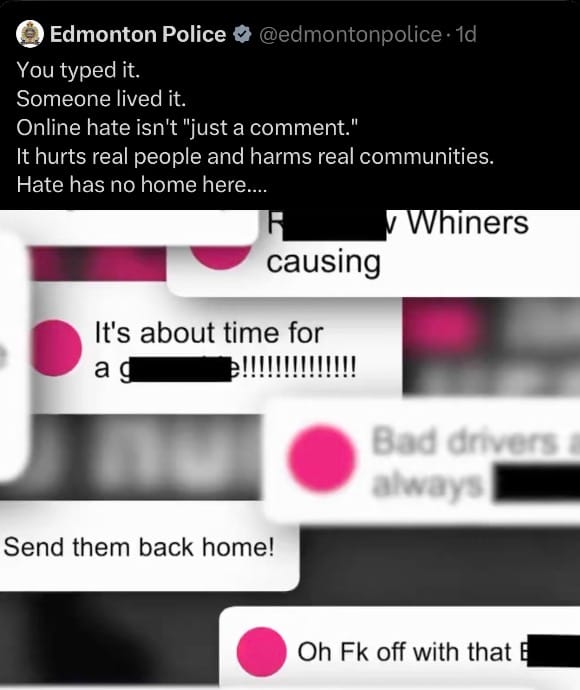
The video went up on Aug. 2 and was gone from the force's X account later the same day. It showed sample posts of the kind the service wanted reported, and those examples drew criticism.
Free speech advocates and MPs argued that some or all of them did not meet the legal threshold for criminal hate speech, and the backlash centered on comments about deportation and telling some immigrants to "go back home." The message with it said, "Online hate isn't 'just a comment.' It hurts real people and harms real communities. Hate has no home here." It also offered a link for reporting.
It stayed up on the service's Facebook and Instagram accounts after the X post came down, and the campaign includes bus advertising urging the public to call police with online hate speech tips.
Conservative MP Andrew Lawton wrote, "Some of these posts call for violence and could meet criminal threshold, but I struggle to see how most of these sample hate posts would be illegal (which is different from offensive, hurtful, uncivil, etc.)." He added, "This is precisely the chilling effect I warned about with Bill C-9."
Ontario MP Roman Baber wrote on X, "No Edmonton police, you have no jurisdiction to limit online speech unless a criminal law is broken."
Bill C-9, the Combatting Hate Act, received royal assent on June 18, 2026 and came into force on July 18, two weeks before the Edmonton post went up. It expands Canada's "hate speech" offenses, raises penalties, and removes the good-faith defense that had shielded a person who expressed an opinion on a religious subject or one based on a religious text. Prosecutors no longer need the attorney general's consent to bring hate speech charges.
Justice Minister Sean Fraser said the law was needed to handle a rising wave of hate crimes, citing police data indicating that Jewish, Muslim and other communities were being targeted more often. On the consent requirement, he said, "By removing this step, law enforcement would be able to act quickly."
The Justice Centre for Constitutional Freedoms, a legal advocacy group, said in July that it was receiving reports of Canadians being contacted at their homes by government officials about social media posts made months or even years ago. Those reports began arriving after C-9 cleared Parliament, the group said.