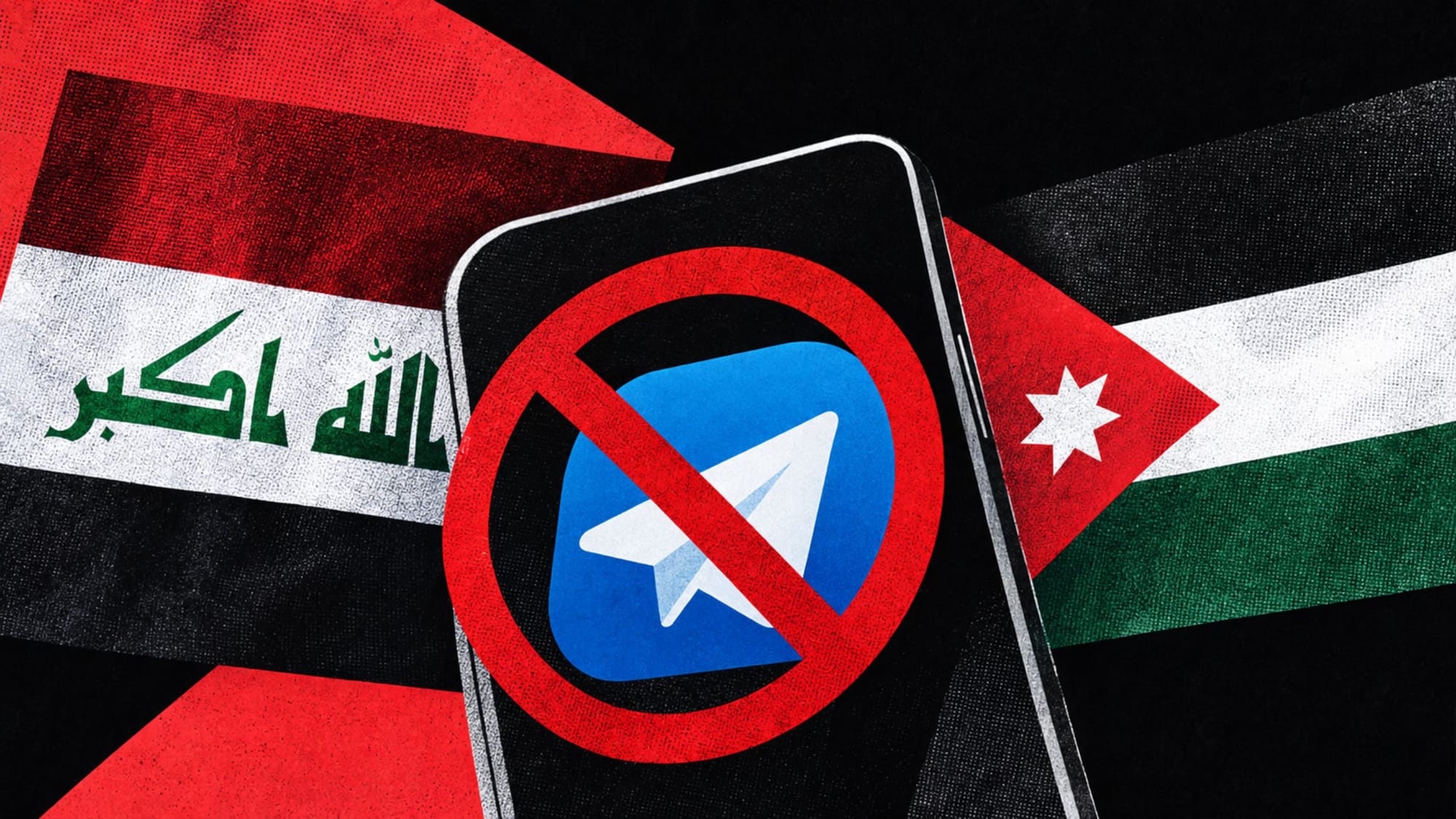
Iraq and Jordan on Monday both cut off Telegram across their entire territories.
In Iraq, the decision was made by the Communications and Media Commission, which announced that it had “decided to ban the Telegram application.”
This was done on the orders of Prime Minister Ali al-Zaidi, and the commission said it was to make Telegram “review Iraqi content published through the application, take the necessary measures to prevent violations, and cooperate with the Commission” – as translated from Arabic.
Iraq gave Telegram 30 days “to settle its legal status” – and the threat of the ongoing ban is not the only one the app has been under in the country. According to the commission, Telegram did not “take the necessary measures to deal with the violating content” – but no examples were given of what that content might have been, nor the channels or users who posted it.
Nevertheless, the commission said that “Protecting society and maintaining national security are a priority in regulating the work of digital platforms.”
The commission also said that the purpose of the ban is to stop what it said was “extremist rhetoric and incitement to sedition, violence and hatred.”
In Jordan, the Public Security Directorate said that Telegram was blocked “in the framework of efforts aiming to bolster digital security and protect users.”
The reason was given as “cyber crimes, threats, blackmail or spreading illegal content” as well as “attempts to spread radicalization and extremism which affect national security.”
This happened after a church in Karak was attacked on October 23, leaving nine dead, and a November 5 stabbing in Amman that killed one security officer. Three men were sentenced to death over the church attack on Sunday.
Meanwhile, citizens have been told to report “illegal content” on Telegram “through official channels.”
It’s not the first time Jordan has blocked an app – in December 2022, TikTok got the same treatment over videos that the authorities said were “inciting killing and chaos.”
In Iraq, the app is widely used by government institutions, media, and armed groups. And the ban comes amid a power struggle between the prime minister and a powerful Iran-backed faction, whose supporters are among the app’s most active users.
The app was briefly restricted in February during the war, but this was not an official ban.
Telegram’s founder Pavel Durov has not yet commented on the latest developments. Previously, he has denied any wrongdoing, and said that Telegram has “exceeded its obligations to moderate content and cooperate with authorities to fight crime.”
Durov has himself been charged in Russia with aiding terrorist activity, and the FSB wants him on an international wanted list.
This is not the first time Telegram has been blocked in a whole country. In 2022, a Supreme Court justice in Brazil, Alexandre de Moraes, suspended the app, only to lift the ban two days later, when Telegram blocked the accounts in question and appointed a legal representative in that country.
In the same year, Germany’s interior minister threatened to ban the app, but the threat was lifted after Telegram blocked 64 channels and the ministry praised its “greatest possible willingness to cooperate.”
In June, India blocked Telegram after an exam leak that originated among insiders. Durov reacted by saying that the move “punishes 150M+ ordinary Telegram users in India.”
Australia’s eSafety commissioner Julie Inman Grant has also said that the country could “apply to the federal court and ask that the service be ceased.”
A nationwide block is not a way to catch extremists, but a way to take a whole country hostage in order to force a company to censor on the government’s behalf. And Iraq has now explicitly stated this in a written document. Every time a platform gives in to this type of pressure, the next government learns that switching off an app for a whole country is an effective tool to get what it wants.