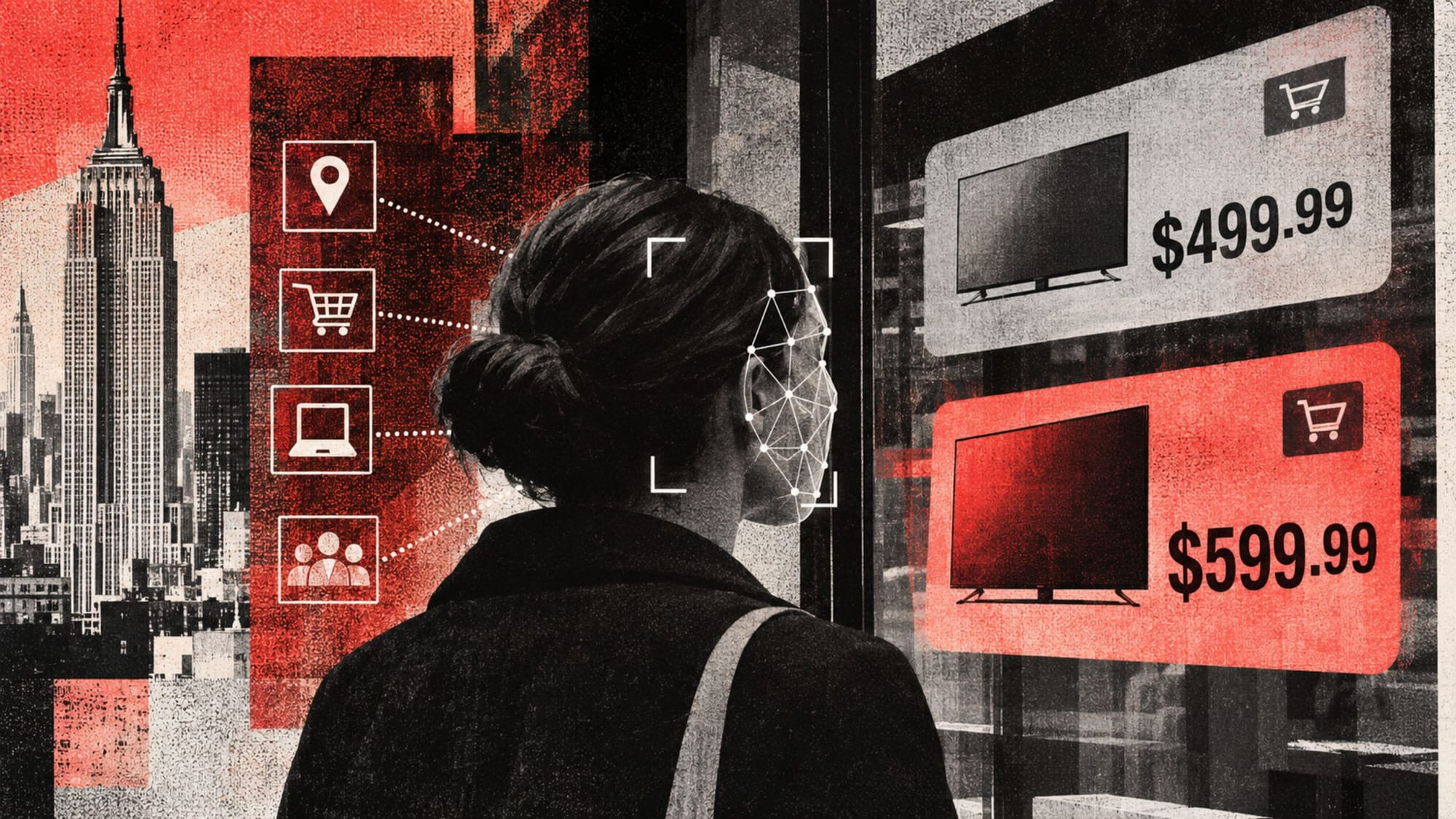
New York City has become the latest US jurisdiction to ban “surveillance pricing” – the practice of using personal data to set prices.
The Big Apple is by no means alone in this: similar bans have been enacted in Seattle, and in the states of Maryland, Connecticut, and New Jersey.
While New York City Council’s November 12 vote is a clear win for privacy and consumer rights, the bill still has to be signed into law by the mayor, and it will take a year after that to come into force.
Meanwhile, the definition of “surveillance pricing” in the bill is that it is pricing “set completely or in part by an algorithm that uses personal data to offer different prices to different customers for the same goods or services.”
Personal data is defined as “any data that identifies or could reasonably be linked, directly or indirectly, with a specific consumer or device.”
The bill’s sponsor, Speaker Julie Menin, has no doubt that this is harmful, and said in a memo that it means setting individualized prices based on “personal data collected about consumers’ characteristics and behaviors, like location, demographics, browsing patterns and shopping history.”
According to Menin, “when corporations use algorithms and personal data to charge different people different prices for the same products, it’s unethical and worsens our affordability crisis.”
The council also gave examples of how this works in real life, such as a grocery delivery platform experimenting with prices, with some customers seeing them “as high as 23 percent” different, while another example shows a TV’s price going up from $499.99 to $599.99 as soon as a customer pulls into the store’s parking lot.
Menin’s memo also states that it is “viscerally offensive to consumers to think about the fact that they are being basically sized up for their willingness to pay more” – and that is a quote from George Slover, of the Center for Democracy and Technology.
The bill also seeks to prevent anyone from collecting, selling, retaining or disclosing personal data “for the purpose of facilitating surveillance pricing.”
The bill does make exceptions for what it calls “bona fide discounts” that are not based on personal data, such as bulk or subscription deals, end-of-season and flash sales, inventory-based pricing, price matching, and rebates.
Another exception is “bona fide custom discounts” that a shopper is aware of, such as those received because of membership or loyalty programs, or based on purchase history.
However, Consumer Reports warned that even this rule is not absolute, as retailers can still use location data to charge more in neighborhoods with fewer stores. And purchase history, the group said, “can be used to profile shoppers and infer information about their family, income, and lifestyle.”
These exceptions were not removed from the bill, despite the warnings.
The council also carved out an exception for location data that a shopper shares with a business, allowing the latter to use it to calculate trip duration and mileage costs, as well as “to assess current or historical local supply and demand conditions” or for “aggregating local marketplace conditions.”
The ban also does not apply to securities broker-dealers and registered investment advisers, who can use “assets under management, account characteristics, or the customer relationship” to set prices.
Insurers are also exempt, as is credit pricing based on a consumer report under the Fair Credit Reporting Act, and “pricing required or expressly authorized by federal or state law.”
The bill also states that service providers are not liable unless they show “reckless disregard” of the law, and small businesses have 30 days to fix a first violation.
For every other violation, the fine can be up to $1,000, with each customer or transaction counting separately.
The Department of Consumer and Worker Protection is tasked with enforcing the bill, while the corporation counsel can investigate and subpoena, and the city can go to the state supreme court to seek injunctions and restitution.
Businesses that use personal data for pricing or custom discounts have to keep procedures that allow customers to learn “what personal data is considered and how the personal data was considered when setting particular prices” – and they have to hand over these procedures, along with “all personal data referenced in such procedures” to the city “electronically upon request.”
The New York City Council voted in favor of the bill on November 12, 44-5.
After the vote, Mayor Zohran Mamdani posted on X, “Some companies use your personal data, like browsing history, to serve different prices to different costumers. It’s called surveillance pricing, and we just banned it in New York City.”
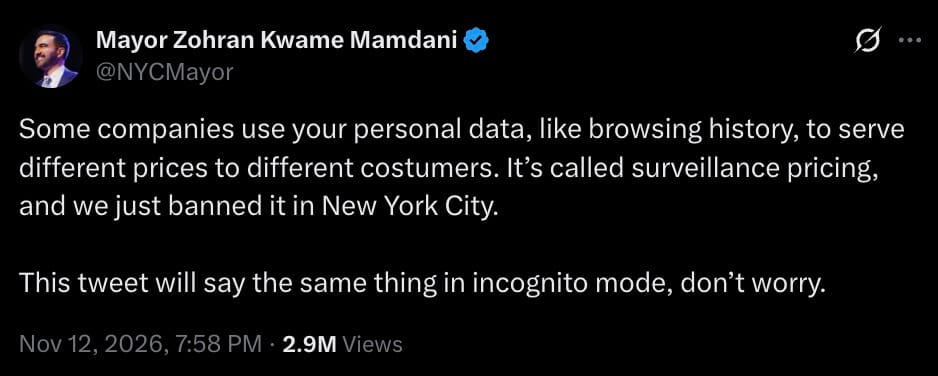
He also reassured those reading the post that “this tweet will say the same thing in incognito mode, don’t worry.”
Mamdani’s post is a bit premature – he has yet to sign the bill into law.
The new rules would be incorporated into the city’s administrative code as section 20-709.1.
If the bill becomes law, New York City would join Seattle, where a ban was signed last month, and states like Maryland, Connecticut, and New Jersey, who already have similar legislation.
According to Consumer Reports, this means that “eight million fewer people will have to guess about whether their search history, what they are hovering over online, and more, is shaping the price they see.”
The group’s senior policy counsel Grace Gedye believes that companies might just apply the rule to their entire business, rather than just the city.
“If they already have to do it for New York City, they may decide to do it for the rest of the country at the same time,” she said.
Meanwhile, a similar bill, the One Fair Price Act, has been passed in the New York State legislature in June, but is still awaiting Governor Hochul’s signature. Consumer Reports noted that Hochul has the power to strengthen or weaken that bill as a condition of her signature.
Reclaim The Net has been following the “surveillance pricing” legislative efforts in various US states, and reported about Michigan’s bills that seek to ban the practice, and California’s, that died in August.
Writing about Michigan, we noted that “the price you see on the screen is becoming a verdict on the person looking at it.”
We also reported about Delta Airlines using AI to set prices for about 3 percent of its domestic sales, with the goal of reaching 20 percent. New York already requires companies to inform customers in capital letters if algorithms using personal data have played a role in setting a price.
The fact that New York City has now taken this step is a step in the right direction, even if it does not cover all instances of personal data collection and usage, such as those done through loyalty cards. The new rules will still allow businesses to profile customers and raise prices based on their purchase history, and the city will be able to demand that data for itself.