

The EU’s digital identity wallet is voluntary. That’s the official position, repeated often enough that the European Commission felt the need to label the opposite claim a “myth.”
Under the eIDAS 2.0 regulation, use of the wallet is voluntary and free of charge for citizens. Nobody will be forced to download the app. Nobody will be compelled to link their government ID to a smartphone.
The EU has been very clear about this.
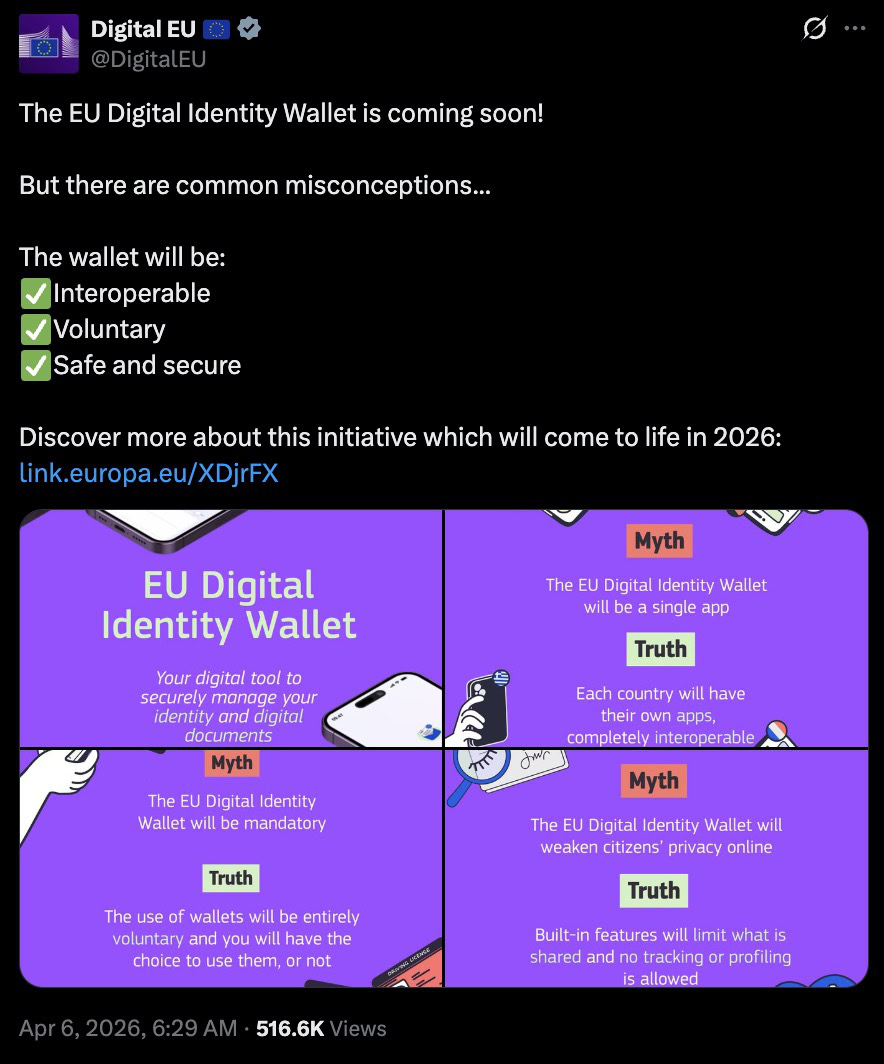
Germany is now showing everyone what “voluntary” actually means.
The country’s Social Democratic Party (SPD) has proposed making the EUDI Wallet the tool for accessing social media platforms, tying the proposal to an impulse paper circulated ahead of a CDU federal conference in Stuttgart.
The plan creates a three-tier system. Children under 14 would face a complete ban, with platforms required to “technically prevent access.” Users aged 14 to 15 would get youth-only platform versions with restricted algorithmic features, and everyone 16 and older would need mandatory EUDI Wallet verification.
That last category includes every adult in Germany. The wallet that nobody is forced to use becomes the only way to access Instagram, TikTok, or Facebook.
SPD leader and Vice-Chancellor Lars Klingbeil framed this as an evolution in his own thinking. “A few years ago, we all emphasized the freedom of the internet and said that there should be no restrictions whatsoever,” Klingbeil said. “But now we see in the debates that something is happening in society, that young people are coming to me and saying we need clear rules on how to deal with social networks. We need restrictions… and we need to make decisions about that now.”
SPD Secretary General Tim Klüssendorf confirmed the party is pushing the proposal forward, and he’s already in talks with coalition partner CDU, Chancellor Friedrich Merz’s party, which called for an end to online anonymity the previous week. Both governing parties now want the same thing. Klüssendorf called it a matter of child protection. “We are currently not meeting the state’s obligation to protect. I believe children and young people are particularly at risk there. That has been proven,” he said after an SPD leadership meeting in Berlin. The platforms, he added, are currently “operating a business model that is simply not compatible with our democratic principles.”
The privacy architecture of the EUDI Wallet is designed, at least on paper, to share less than traditional ID checks. The system uses a selective-disclosure mechanism that lets a user confirm they meet a specific age threshold without revealing their name, address, or full date of birth. A cryptographic proof goes to the platform. The platform gets a yes or no. Your legal identity stays on your device.
That’s the theory. The SPD’s proposal starts dismantling it almost immediately.
Users between 14 and 16 would only be able to access social media through a parent or guardian’s EUDI Wallet app, tying account access to the identity credentials of an adult. For everyone 16 and older, algorithmic content recommendations would be switched off by default, and opting back in would require active consent.
Every login, every account creation, every new platform signup passes through a government-issued digital identity. The wallet confirms your age, sure. But the act of verification itself creates a record that you accessed a specific service, at a specific time, from a specific device.
Klüssendorf insisted the SPD wants “a very data-minimising solution that is also in the hands of state regulation” rather than handing platforms more user data. Instead of Meta profiling your behavior to guess your age, the German state would verify your identity before you’re allowed to participate at all. The surveillance doesn’t disappear. It moves from the private sector to the government.
The proposal gets more aggressive when it comes to enforcement. Klüssendorf said the goal must also be that workarounds “such as via a VPN tunnel” would not work. There’s no clean technical mechanism for that. Blocking VPN circumvention at scale requires either forcing VPN providers to verify users themselves, deep packet inspection of internet traffic at the network level, or both. These are the same tools that authoritarian governments deploy to control what their citizens can see online. Germany would be reaching for them because teenagers use TikTok.
The broader EU framework around the wallet tells its own story about where “voluntary” is heading. Under the eIDAS 2.0 regulation, all Very Large Online Platforms and companies required by law to use strong customer authentication must accept the EUDI Wallet by late 2027.
The EU’s own Digital Decade target aims for 80% of citizens to use a digital ID solution by 2030, with the EUDI Wallet as the primary instrument for reaching that goal. You don’t set an 80% adoption target for something you genuinely intend to keep optional.