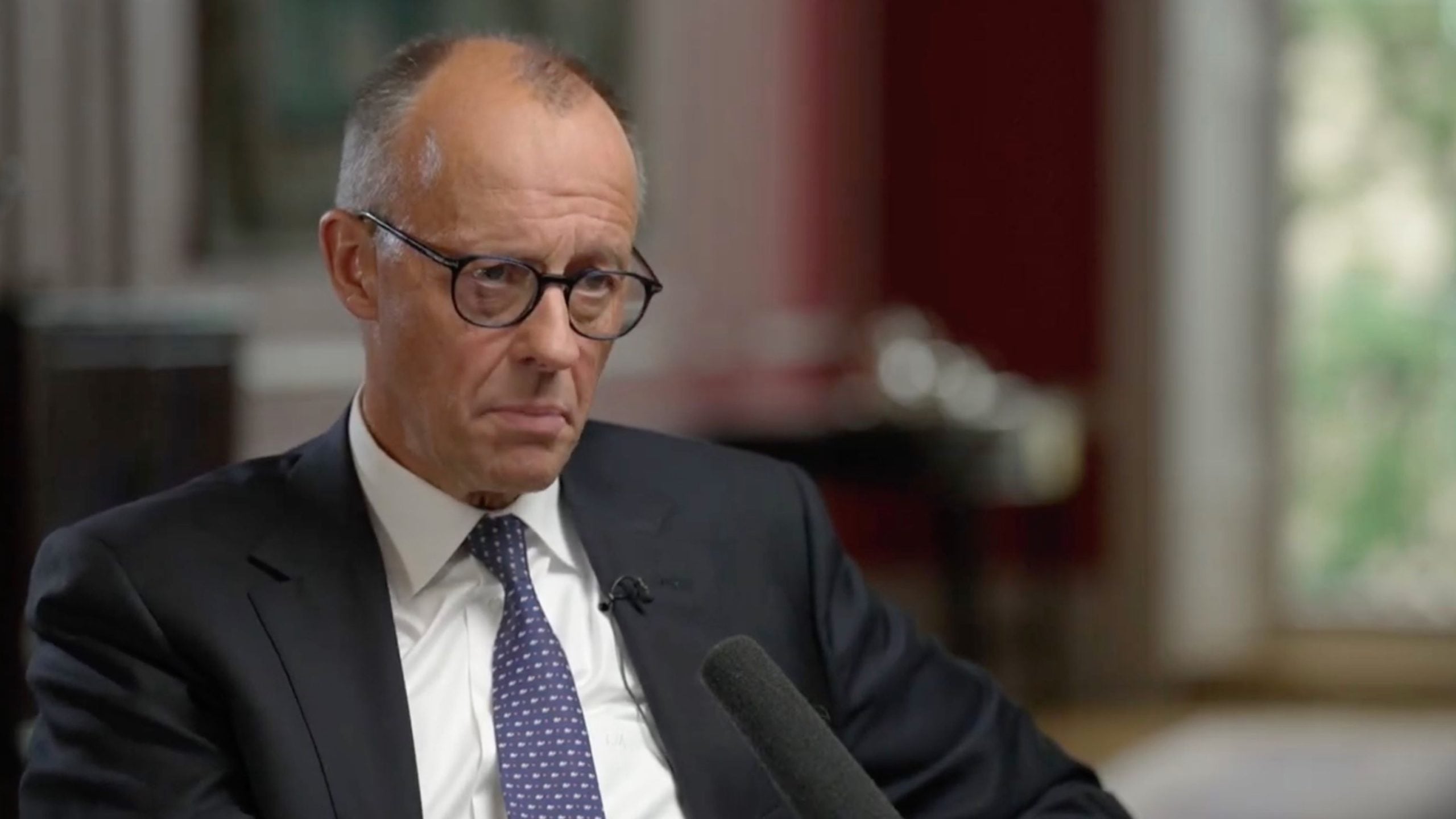
A handful of Germans now owe the state money for what they typed under a police Facebook post. Their offense was calling Chancellor Friedrich Merz names.
Two of them drew fines of €2,000, roughly $2,326, the larger sum tied to thirty daily income units rather than a flat penalty, which means the punishment scales with how much you earn.
The comments landed under a Heilbronn police announcement about Merz visiting the city in October 2025. One user tagged the chancellor “Lügenfritz,” a play on “Lying Fritz,” Fritz being the diminutive of Friedrich.
Another went cruder, writing “Ftzn Frieder,” a truncation that points at a German term for a woman’s genitals. Both got the same €2,000 penalty. The Amtsgericht Öhringen in Baden-Württemberg issued the order against the “Lügenfritz” commenter, and it is now final.
More: Germany’s War on Jokes
Here is the reasoning the prosecutor’s office gave for going after a Facebook insult. The remark, they argued, had the potential of “undermining confidence in the victim’s integrity, because it was liable to foster further negative prejudices or even aggression among like-minded individuals.”
A man’s reputation becomes a thing the state protects by fining strangers who comment on a police page. The “victim” is the sitting head of government. The prosecutor acted on an assumed “special public interest,” and Merz himself was never even brought into the case.
The legal hook for all of this is Section 188 of the German criminal code, which covers insult, malicious gossip, and defamation aimed at people in political life.
It hands officials a tier of protection ordinary Germans don’t get. Insult your neighbor and little happens. Insult the chancellor and a prosecutor in Heilbronn decides whether your sarcasm threatened public trust.
The outcomes across these cases expose how arbitrary the line is. Of 39 social media comments the prosecutor’s office reviewed, it dropped 15.
Police forwarded 38 comments from under that single post for criminal assessment, and prosecutors sought formal penalty orders in four of them.
Calling Merz “Lackaffe,” a “pompous fool,” brought a penalty order too, but that defendant fought back, and the court closed the matter for a €100 payment.
That settlement was not an acquittal.
A court spokeswoman stressed the dismissal actually assumed the comment was punishable. You pay and the guilt is presumed anyway.
Other labels walked free, for now.
“Pinocchio” was cleared. So were “Lügen-Kasper” (“lying clown”), “verlogener zweite Wahl Kasper” (“dishonest second-rate clown”), and at least one “Lügenbaron” (“baron of lies”).
The Stuttgart and Tübingen prosecutors closed their cases for lack of any initial suspicion of a crime.
The Pforzheim office, having received one “Lügenbaron” comment, decided not to pursue it.
The office judged the phrase “als eine von der Meinungsfreiheit gedeckte, zulässige Machtkritik;” permissible criticism of power, covered by free expression.
So one prosecutor sees protected speech where another sees a crime worth a month’s wages. The citizen has no way to know in advance which office will catch the file, which means anyone tempted to vent at a politician online is now gambling.
When the cost of a Facebook comment might be €2,000 and might be nothing, depending on which jurisdiction processes it, the rational move is to say nothing. The chilling effect doesn’t need a conviction rate to work. It needs the headlines, and Germany now has plenty.
This is not a one-off either. The crackdowns have been building for years, the most notorious case was the dawn raid on Bavarian pensioner Stefan Niehoff, who has since died, whose home was searched after he reposted a meme calling a government minister a “professional idiot.”
Prosecutors are now fielding thousands of these referrals annually, with police and activist monitoring outfits scanning posts and flagging them upward.
The opposition AfD has called for Section 188 to be scrapped entirely. The party’s position is that special rights for politicians must not exist and that all citizens have to be treated equally before the law.
An attempt to repeal Section 188 already failed in the Bundestag this past January, with every other parliamentary group voting to keep it on the books.
What’s left is a law that lets the powerful decide when mockery becomes a crime, applied unevenly across offices that can’t agree on whether “baron of lies” is defamation or democracy.