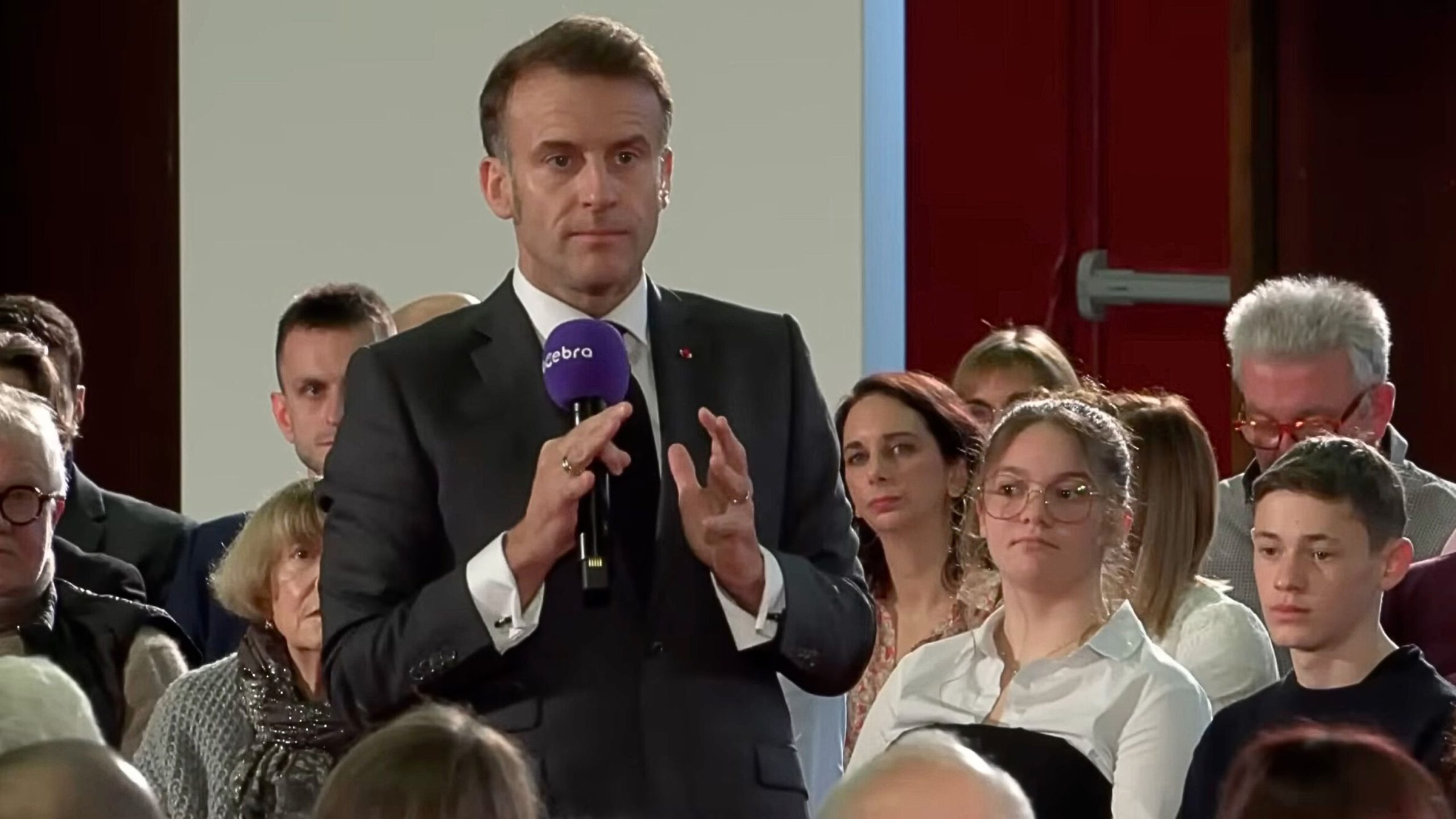
At a recent Q&A with readers of The European Business Registry Association (EBRA Group), French President Emmanuel Macron sounded like a man exhausted by the open internet.
“We are not necessarily aware of it,” he began, describing a Europe under siege from fake news online. The French president, flanked by reporters from the country’s biggest regional press group, outlined what could only be described as a national security doctrine for memes.
He called it an “informational and cognitive war.”
The plan, delivered between polite applause and nodding journalists, is a major expansion of France’s digital control architecture: fast-track censorship orders, new powers for state agencies, a legal war against “false accounts,” criminal liability for platforms, and a promise to ban social media for anyone under fifteen, enforced by the same age-checking system used for pornography.
The speech was a kind of legislative fever dream, where misinformation, harassment, and child protection were all conflated into a single moral emergency requiring more state authority and faster judicial reflexes. Macron’s frustration was clear. He wants the ability to hit delete.
France already has a government office for this, Viginum, an agency dedicated to tracking “foreign digital interference.”
But according to Macron, the only thing it can currently do is “ask for the withdrawal of all this information when they are identified as interference.”
That, he complained, is “extremely long, complicated, slow.”
His solution is a “real system of platform responsibility.”
Platforms should be treated like newspapers, liable for anything that slips through their servers. “If there was false information pushed into one of the EBRA Group’s titles,” Macron told the assembled journalists, “I would ask you to remove it or to vigilize it.” That last word, a Macronism worthy of its own ministry, roughly translates to “do more censorship, faster.”
The president seems genuinely vexed that online speech is not easier to delete.
He recounted the case of a viral post claiming that France had sent 1,000 legionnaires to Ukraine, a story he said “circulated and was seen millions of times.”
His conclusion: the internet needs to be industrially managed, with “teams on a daily basis” fighting disinformation like a standing army.
When Macron talks about online control, the vocabulary veers from bureaucratic to clinical.
He praised prebunking, a tactic where the government “prepares the minds for this vigilance” by preemptively flagging narratives as false before they spread. In this world, the public is a population to be inoculated.
“This is the battle that must be fought before the elections,” he said. “It is not normal to have these hidden armies.”
The metaphor of war suits Macron. Fake accounts are combatants, misinformation is a weapon, and the French voter is a battlefield to be defended from thought contamination.
His answer is “to ban them, because that’s the basis of everything.”
Macron’s relationship with Silicon Valley has all the warmth of a tax audit. When he is not fighting “foreign powers,” he is fighting the Americans themselves, or at least their tech companies.
“The big companies behind the US administration…want to continue to make the most money without any responsibility,” he said, accusing Washington of trying to “remove” the European Union’s new censorship law, the Digital Services Act.
That law, which gives EU governments new tools to regulate online speech, has been too slow for Macron’s taste. He said some French cases have been “in front of the Commission for two years.”
To fix that, he wants more national control, faster judicial takedowns, and tougher European enforcement. “We have to harden our law,” he said.
The president’s solution to online chaos is to extend France’s “fake news” law, originally designed for election-related falsehoods, to everyday citizens. Victims of “false information” or “information that is an attempt to your dignity” could soon request a court order forcing removal within 48 hours.
Macron’s own grievances made the proposal sound personal. “We are totally stripped of our rights,” he said, referring to online rumors about his wife.
His conclusion: platforms “must have an editorial responsibility.”
In other words, social networks should function like newspapers, except with billions of contributors and government-mandated content filters.
Then came the family values portion of the show. Macron announced that France will “ban social media before the age of 15,” invoking the moral precedent of the old wine ban for minors. “Sixty years ago, we served wine to kids,” he said. “We have banned it.”
The comparison, TikTok as Bordeaux, was vintage Macron: earnest, vaguely absurd, and wholly confident. The enforcement mechanism will be an age verification digital ID system. Platforms will be required to check user ages through “techniques that are completely re-de-stabilized,” a phrase that left even the translators blinking.
It is worth noting that the law banning under-15s from social media already exists. It just has not been implemented yet. Macron’s plan, he explained, is to make sure this “digital majority” becomes real through national law and European backing.
Macron closed by promising that France will introduce the necessary “law texts” in early 2026, along with a “series of European initiatives.” The idea, he said, is to be “better armed” before the next wave of online interference.
It was an oddly militarized image for a policy about content moderation, but perhaps fitting. The president seems to see himself less as a politician than as commander of a vast information garrison, defending France’s cognitive borders against chaos, memes, and unruly teenagers with smartphones.
The plan’s success depends on how far the French public is willing to go in trading digital freedom for digital hygiene. Macron calls it responsibility. His critics might call it paternalism with a dashboard.
Either way, France is about to find out what happens when a liberal democracy decides to put the internet on probation.