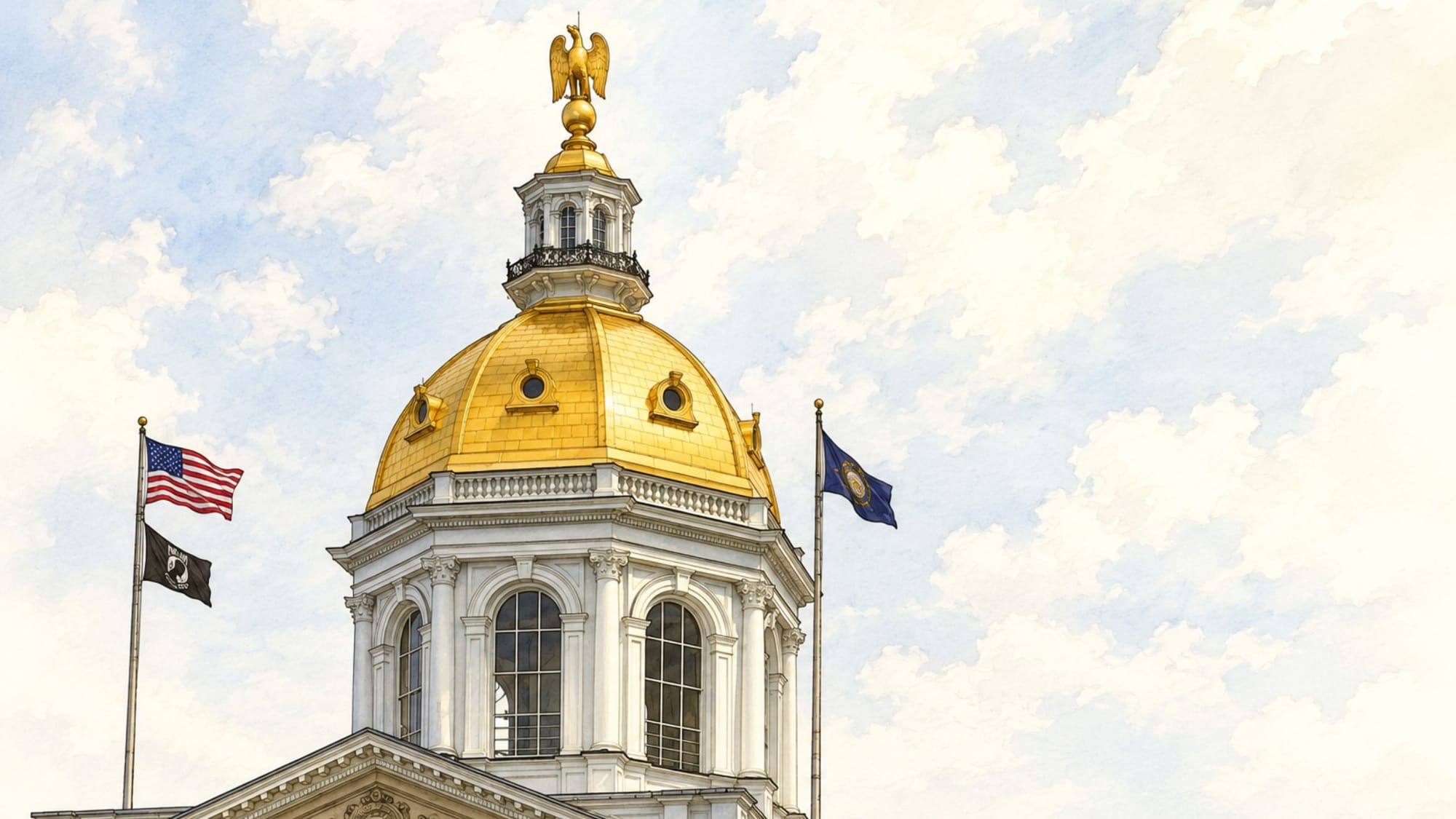
New Hampshire State Rep. Calvin Beaulier has submitted a legislative proposal that would prevent the state’s courts, agencies and personnel from being used by foreign censorship authorities to go after speech that is protected in the US.
The effort is one of several around the country, a growing movement, and is based on model legislation called the GRANITE Act. The New Hampshire proposal, which has not yet been published, was filed as a Legislative Service Request (LSR) by Beaulier on September 1.
LSRs are used to prepare a bill or resolution before the legislative session begins. The New Hampshire General Court’s public list of LSRs shows the proposal as a House bill, with Beaulier as the prime sponsor, and describes it as prohibiting the recognition, enforcement, or cooperation with any foreign judgment, order, or demand that seeks to penalize constitutionally protected speech.
Beaulier calls it the New Hampshire GRANITE Act. “Foreign governments keep trying to export their censorship laws and intimidate us for speaking freely,” he said in a video announcing the filing.
“The New Hampshire GRANITE Act puts a stop to that. Our courts will not recognize any unconstitutional foreign gag orders or fines. Our state agencies will not cooperate or assist with any attempts to enforce them.”
He concluded: “With the New Hampshire GRANITE Act, New Hampshire will be the world’s granite fortress of free speech.”
The model for this legislation is championed and co-written by American attorney Preston Byrne, who said that Beaulier’s bill follows the American Legislative Exchange Council (ALEC) national model, and that he had been involved in drafting an earlier New Hampshire GRANITE Act that was circulated to representatives in October 2025.
Byrne also noted that the ALEC model was finalized on August 12, after being introduced as model policy on July 24. The model defines a foreign censorship law as one that restricts, penalizes, or compels disclosure about speech, expression, association, or content protected by the US First Amendment and the relevant state constitution.
If the New Hampshire bill follows the ALEC model, no state court will be allowed to recognize, enforce, or execute a foreign judgment, fine, order, or demand based “wholly or partly” on such a law. Furthermore, state agencies, officials, and employees would be prohibited from cooperating with or supporting enforcement of such foreign laws, including through service of process, information sharing, or other assistance.
The model bill states that it is defensive in nature and consistent with the federal SPEECH Act, which has a similar goal of preventing foreign defamation judgments from being recognized or enforced in the US.
In other words, the proposed legislation does not have the power to stop a foreign regulator from taking action against a company’s assets, staff or operations abroad – but it would prevent that regulator from using the machinery of the state of New Hampshire to enforce its censorship laws.
A federal GRANITE Act, H.R. 10174, was introduced in the US House of Representatives by Ohio Rep. Michael Rulli on August 27, and referred to the House Judiciary Committee. Rulli’s bill would prevent US courts from recognizing or enforcing foreign censorship judgments, fines, orders, and demands, and allow a US person targeted by such a demand to seek a declaration that it is unenforceable in the US.
According to Rulli, “My bill makes clear that if a foreign government tries to punish an American for speech protected by the First Amendment, that judgment is dead on arrival in our courts.”
The flurry of legislative activity around the country – including in New Hampshire, Wyoming, and West Virginia – is a reaction to attempts by foreign online-safety and censorship regulators to go after US-based speakers and platforms.
The New Hampshire legislative session begins on January 6, 2027 so we’ll be looking out for it.