
Ofcom has now fined 4chan £520,000 ($691,572) under the Online Safety Act. The platform hasn’t paid a penny and isn’t intending to. Its lawyer replied to the latest demand with a picture of a hamster.
That’s the state of UK online speech regulation in 2026: a regulator issuing fines to American websites, receiving rodent-themed correspondence in return, and collecting almost nothing.
The breakdown: £450,000 for failing to put age verification in place, £50,000 for failing to assess the risk of illegal material being published, and £20,000 for failing to set out in its terms of service how it protects users from criminal content. Ofcom says 4chan must comply by April 2 or face daily penalties on top.
But this confrontation and push for 4chan to start checking IDs didn’t start with a £520,000 fine. It started with an email sent across the Atlantic to a company that owes the UK government nothing.
4chan is an American platform. Its registered in Delaware. Its servers are in the United States. It has no employees in Britain, no offices in Britain, no legal registration in Britain, and no business presence of any kind in Britain. It is, in every meaningful sense, none of Ofcom’s business.
And what good would the First Amendment be if it could be overridden by foreign demands?
When the Online Safety Act came into full force, Ofcom declared that any site with “links to the UK” had duties to protect UK users, regardless of where in the world it was based.
That phrase, “links to the UK,” is intentionally vague, allowing British authorities to demand compliance from virtually any website. Under that logic, any American platform that a British person can visit is subject to UK speech law. No presence required. No UK operations required. Ofcom thinks it has jurisdiction over planet Earth.
Beginning in April 2025, Ofcom sent a “legally binding information notice” to 4chan’s corporate services company, by email, demanding compliance with the Online Safety Act and threatening that failure could “constitute a criminal offence” resulting in a fine of £18 million or 10% of 4chan’s worldwide turnover, arrest, and imprisonment for up to two years.
The notice was sent to a company not authorized to accept service on 4chan’s behalf. No UK court had issued it. No treaty process had been followed. It was, legally speaking, a strongly worded email.
Preston Byrne, the attorney representing 4chan, described the regulator’s actions as “an illegal campaign of harassment” directed at American tech firms, and made clear his client would not comply: “4chan has broken no laws in the United States, my client will not pay any penalty.”
By June 2025, Ofcom had opened a formal investigation.
Byrne’s reply was characteristically direct: “Increasing the size of a censorship fine does not cure its legal invalidity in the United States.” He continued: “After an entire year of your agency’s spectacular failure to get the memo, my only suggestion is that you take a first-year course on U.S. constitutional law.”
In August 2025, 4chan and Kiwi Farms took the fight to the US federal courts. The lawsuit, filed in the US District Court for the District of Columbia, argues that the Online Safety Act is not only an unlawful extraterritorial power grab but a direct attack on foundational American liberties. The complaint states: “Where Americans are concerned, the Online Safety Act purports to legislate the Constitution out of existence.”
The platforms argue that Ofcom’s demands, including written “risk assessments,” content moderation systems, removal of speech deemed “illegal” by UK standards, and user identity verification, would require violating the First Amendment and Section 230 of the Communications Decency Act. Byrne told reporters: “American citizens do not surrender our constitutional rights just because Ofcom sends us an email.”
October 2025 brought the first confirmed fine: £20,000 plus £100 per day. Byrne responded publicly: “4chan’s constitutional rights remain completely unaffected by this foreign e-mail. 4chan will obey UK censorship laws when pigs fly.” He followed up: “You have to laugh. That Americans don’t obey British censors is settled law here; Ofcom might as well have ordered that the Moon be made of cheese.”
Ofcom’s response today was delivered by Suzanne Cater, its director of enforcement. “Companies, wherever they’re based, are not allowed to sell unsafe toys to children in the UK. And society has long protected youngsters from things like alcohol, smoking and gambling. The digital world should be no different,” she said.
“The UK is setting new standards for online safety. Age checks and risk assessments are cornerstones of our laws, and we’ll take robust enforcement action against firms that fall short.”
The children protection argument is politically durable. It always is. The actual reach of the Online Safety Act extends considerably further than child protection.
Under UK law, the “illegal content” category covers forms of speech that remain constitutionally protected in the United States, including material that may be labeled “grossly offensive” or politically controversial.
The UK has no equivalent free speech protections. The government gets to define what “illegal content” means. That definition can shift without Parliament voting on it.
When Ofcom moved to dismiss the US lawsuit, it revealed the central contradiction at the heart of its position. Ofcom claimed sovereign immunity under US law to shield itself from the case, the same legal traditions it was simultaneously dismissing when 4chan cited the US Constitution. The regulator wants to impose its rules on American soil but doesn’t want American courts reviewing whether it can. It wants jurisdiction without accountability.
The lawsuit’s filing accused Ofcom of deliberately targeting the most well-known but financially vulnerable American platforms to make public examples of them, signaling consequences to larger companies that might otherwise resist through the lawful exercise of their constitutional rights.
Indeed, Ofcom’s own confirmation decision stated that “imposing a financial penalty in this case would ensure that both 4chan and the wider sector understand how seriously Ofcom takes compliance with these duties.”
Byrne’s full reply, published publicly, is worth reading. Byrne wrote to Ofcom:
“Thanks. As has been explained to your agency, ad nauseam, the United Kingdom lost the American Revolutionary War. We are not in the mood to discuss the matter further, and have not been in the mood for 250 years.
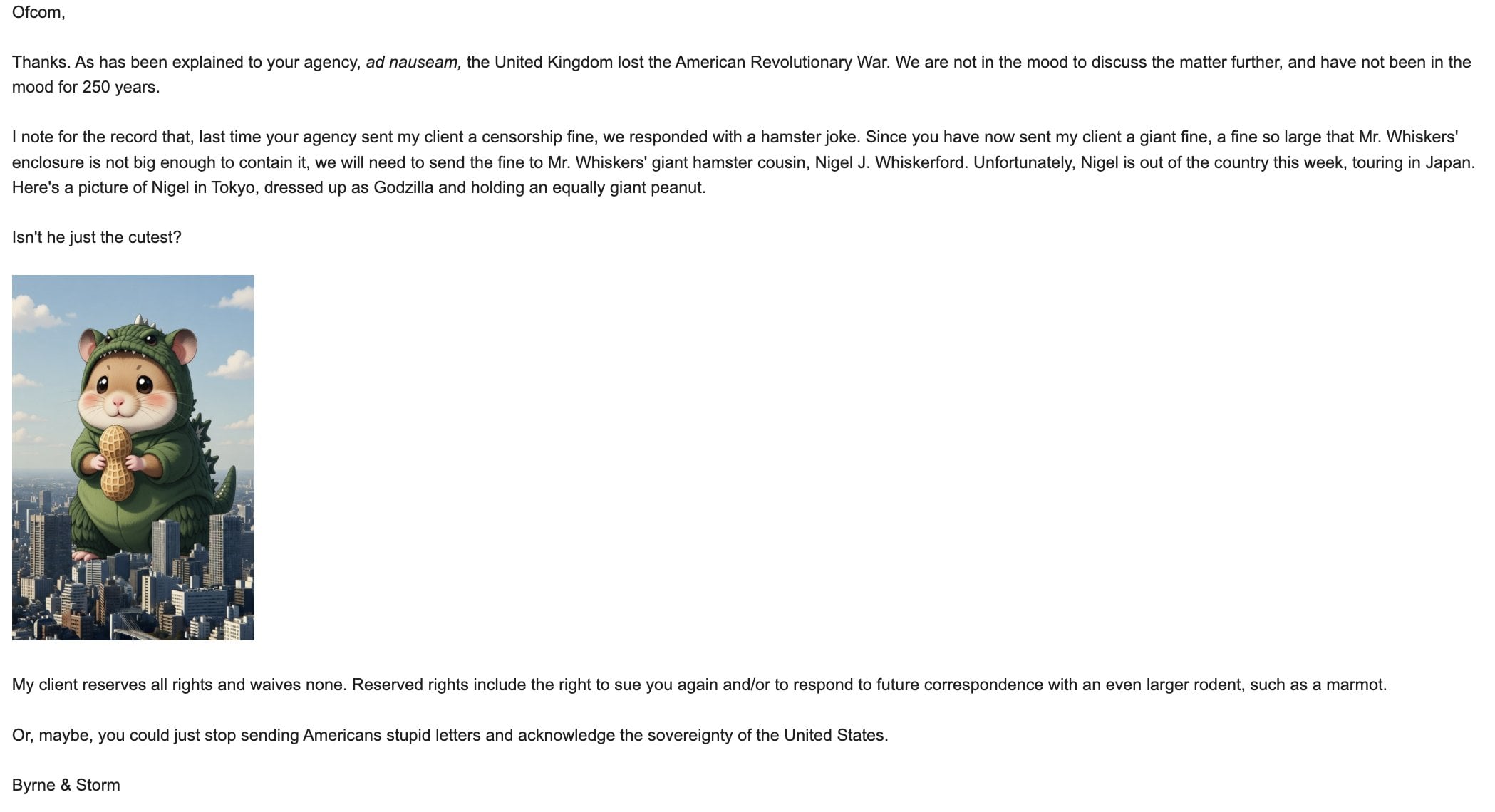
“I note for the record that, last time your agency sent my client a censorship fine, we responded with a hamster joke. Since you have now sent my client a giant fine, a fine so large that Mr. Whiskers’ enclosure is not big enough to contain it, we will need to send the fine to Mr. Whiskers’ giant hamster cousin, Nigel J. Whiskerford. Unfortunately, Nigel is out of the country this week, touring in Japan. Here’s a picture of Nigel in Tokyo, dressed up as Godzilla and holding an equally giant peanut.
“Isn’t he just the cutest?
“My client reserves all rights and waives none. Reserved rights include the right to sue you again and/or to respond to future correspondence with an even larger rodent, such as a marmot.
“Or, maybe, you could just stop sending Americans stupid letters and acknowledge the sovereignty of the United States.”
It is, by any measure, not how regulatory compliance correspondence usually reads. But then, Ofcom’s demands don’t really deserve a more serious reply. Byrne is meeting the regulator precisely at the level its letters warrant.