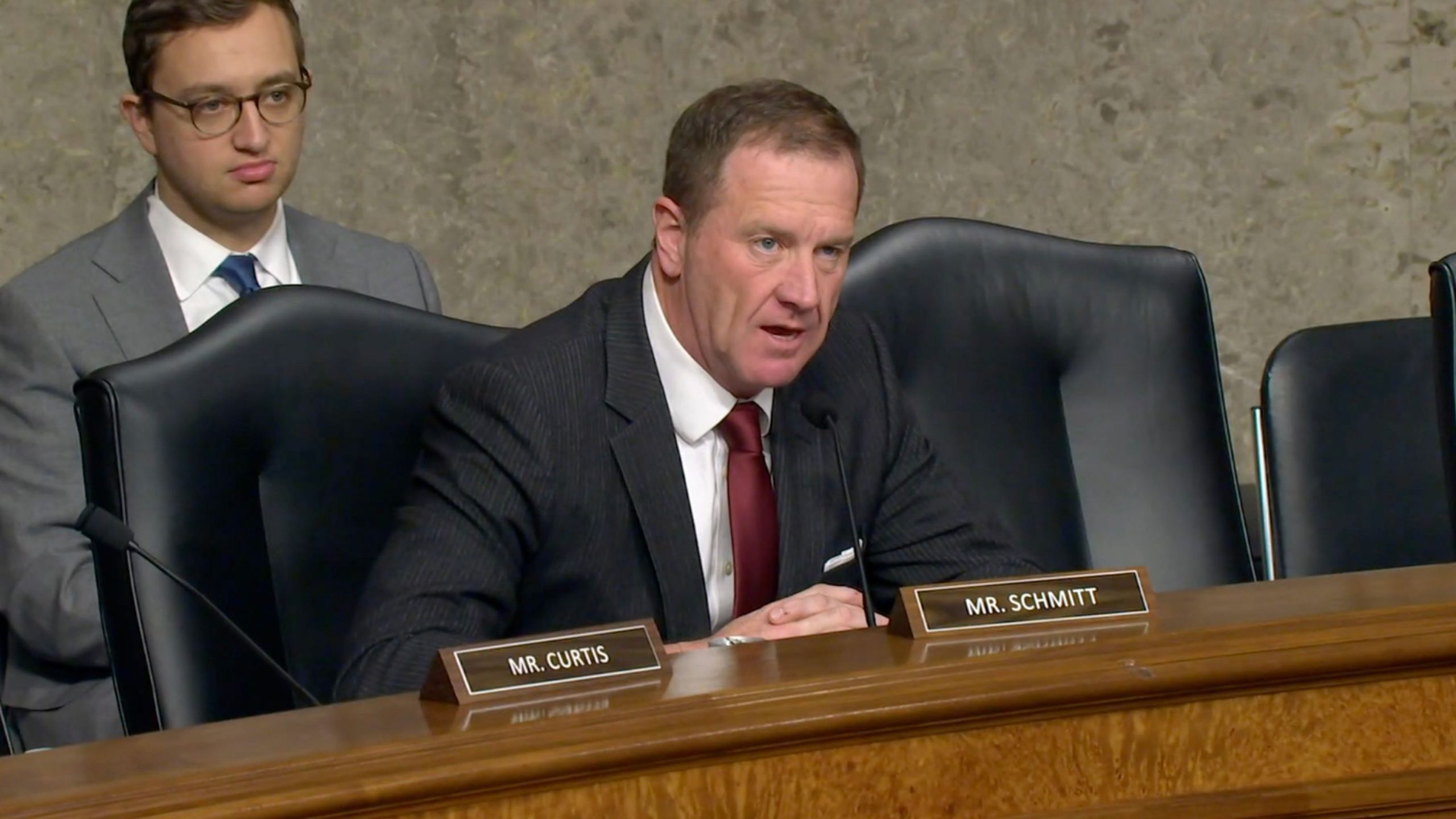
Senator Eric Schmitt has called on the US State Department to impose sanctions and visa restrictions against foreign officials, regulators, and organizations that he says are working to export censorship laws into the United States.
In a December 18 letter to Under Secretary of State for Public Diplomacy and Public Affairs Sarah B. Rogers, Schmitt warned that coordinated efforts by European and other foreign governments pose “threats to American speech and sovereignty.”
We obtained a copy of the letter for you here.
“I write today to express my grave concerns about the threats to American speech and sovereignty posed by an emergent international censorship regime,” Schmitt stated in the letter.
He described the growing influence of European-style digital speech laws as a direct challenge to US independence and warned that these systems aim to “impose hard-left ideological strictures” on American discourse.
He urged the State Department to respond forcefully: “We must confront this campaign of foreign subversion with swift and decisive action. I therefore strongly encourage the State Department to impose sanctions and visa restrictions on the foreign individuals and entities involved in this assault on our freedom of speech.”
The senator pointed to the European Union’s $140 million fine against X, formerly Twitter, under the Digital Services Act as an example of an attempt to force American platforms to align with European content controls.
“The EU’s message to X is clear: This fine is a warning—start censoring Americans or else,” Schmitt wrote.
Schmitt’s letter argues that this international pressure campaign reflects a wider “global censorship-industrial complex” modeled on structures he fought domestically.
“To ensure our government would no longer censor our fellow Americans, I successfully fought to defund the State Department’s censorship apparatus and shutter the Global Engagement Center,” he noted.
He urged the use of the Global Magnitsky Human Rights Accountability Act and other statutory tools to target those advancing censorship abroad.
“Sanctioning the global censorship-industrial complex would not only send an important diplomatic message that the United States will not tolerate foreign censorship but also forcefully deter and punish all the foreign individuals and entities who seek to impose it.”
Schmitt tied his appeal to the principle of national sovereignty: “The fundamental principle of America First demands that we protect our citizens’ fundamental rights from the threats they face from abroad.”
He closed with a broader warning about the stakes for American freedom. “The American people will not abide this brazen foreign censorship. Our Constitution and laws prohibit it. If the United States is to protect the freedoms that form the beating heart of our way of life, then we must fight back and prevent foreign governments from violating our sovereignty and eviscerating our freedom of speech by imposing their censorship laws on our citizens on our own soil.”
Schmitt’s closing argument positions the issue as a matter of national defense rather than internet policy.
He warns that when foreign governments dictate what Americans can say online, they are exercising power over the US public itself.
His push for sanctions and visa bans is meant to flip the script, punishing those who attempt to export censorship instead of rewarding them with diplomatic deference.