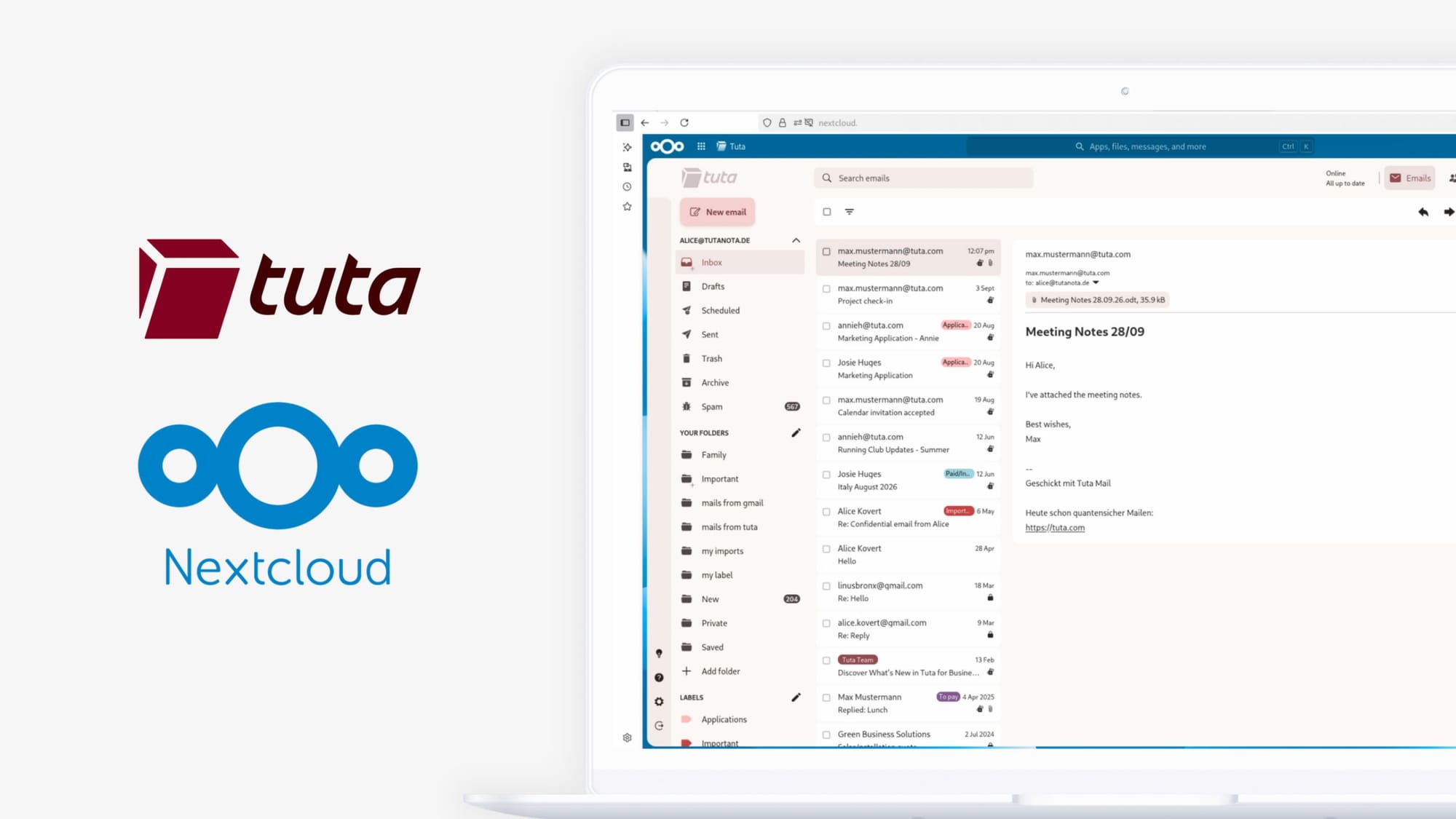
The Nextcloud App Store has a new addition, an app from the German encrypted email company Tuta.
The app, Tuta Mail, covers email, calendar and contacts, while Nextcloud provides file storage, collaboration and communication tools. With this pairing, users will be able to run all these services without having to turn to the giants like Google or Microsoft.
Tuta announced on October 1 that the Tuta Mail app was available in the Nextcloud App Store and at the same time revealed that its own service now has a Nextcloud plugin.
Two features are available now to those using both services: Tuta Mail attachments can be saved directly to a Nextcloud server, and a Nextcloud Talk link can be generated from the location field of a Tuta Calendar event. Another feature, to be added soon, is the possibility of sending Nextcloud files via Tuta Mail.
Tuta said the result of its collaboration with Nextcloud was “all free and 100% European.”
The app in Nextcloud’s store requires version 35 of the server, and was published by Tutao GmbH, with Matthias Pfau listed as the owner.
Other than the convenience of having two popular European digital sovereignty tools integrated, Tuta said the Nextcloud plugin is “our first officially supported one,” and that with it “we have now set the ground for a whole suite of plugins.”
Tuta has published documentation and guidelines for other developers on GitHub, to write their own plugins for the email service. Recently, Tuta published a Thunderbird add-on that allows users to access Tuta Mail accounts inside Thunderbird, alongside other accounts.
However, the Nextcloud-Tuta Mail integration is not simply available to any user who wants it. As Tuta puts it: “if you are a family or business using Tuta Mail, your Nextcloud admin or provider needs to allow you to use Tuta within Nextcloud.”
Tuta adds that “If you are a single user of Tuta, you are the admin of your own account and perform this action yourself,” and that “This only works if you have installed the Tuta Mail app on your own Nextcloud instance.”
In other words, those using Nextcloud on a server provided by their company or organization are dependent on that provider’s decision to allow the connection with Tuta Mail.
The two companies are pitching this integration as a way to replace Google and Microsoft services with “a truly sovereign solution that’s 100% built in Germany, open source, and focuses on best usability combined with best data protection and security.”
However, the announcement also reveals that users are wary of replacing one lock-in with another, and prefer to have “multiple, sovereign solutions” instead of a single one.
In a statement, Nextcloud CEO Frank Karlitschek said that the two companies working together is “exactly the kind of interoperability that makes the open source ecosystem stronger and that gives people a real alternative to the closed ecosystems of Big Tech.”
Tuta CEO Matthias Pfau said that the goal is to make it easy for everyone to leave Google and Microsoft without losing usability, and to “combine secure communication with sovereign file storage and collaboration.”
The question remains: how many conditions, switches, and hoops must a user jump through to achieve true digital sovereignty? It’s getting easier day by day.