The UAE government has decided this is the moment to threaten its 10 million residents with prison for sharing the wrong information online.
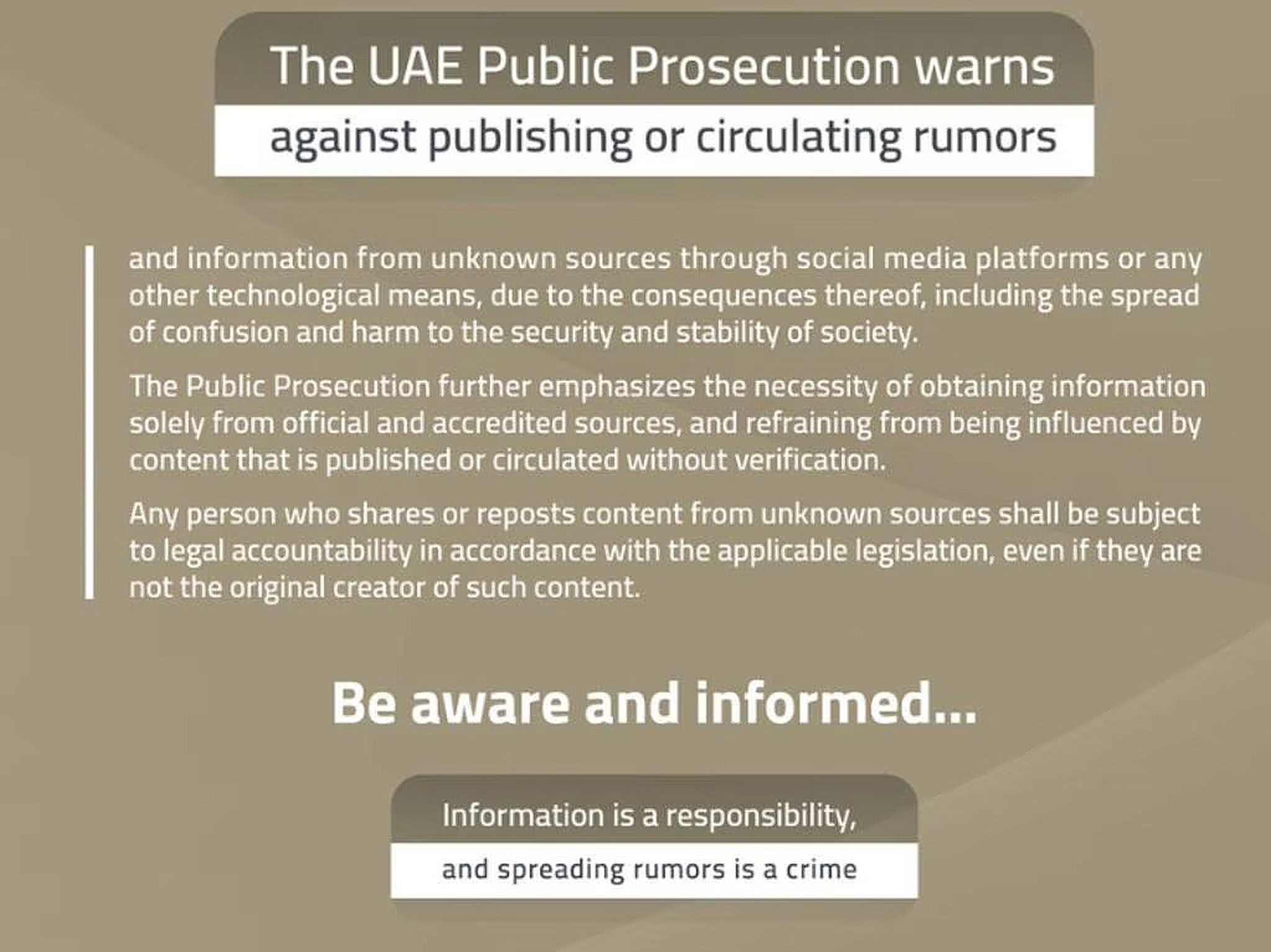
On February 28, as Iranian ballistic missiles and drones struck the country for the first time, the UAE Public Prosecution announced that publishing or circulating “rumors and information from unknown sources through social media platforms or any other technological means” is a criminal offense under federal law.
The warning extends to anyone who reposts such content. Not just people who create it.
“Information is a responsibility, and spreading rumors is a crime,” the Public Prosecution said, directing residents to get their information “solely from official and accredited sources.”
In a country under active missile bombardment, the government has just told its residents that the only permitted source of information about what’s happening to them is the government.
Federal Decree-Law No. 34 of 2021 on Countering Rumors and Cybercrimes was already on the books. This isn’t a new emergency measure rushed through in a crisis.
It carries a minimum sentence of one year in prison and a fine of at least AED 100,000 (around $27,000) for sharing false, misleading, or unverified information online.
Share something the authorities determine “incited public opinion” against the UAE government, or share it during a declared crisis, and the minimum jumps to two years and AED 200,000.
The law has been used before. Authorities in Ras Al Khaimah referred seven people to prosecution for social media content deemed to have “undermined community security and stirred public opinion.” The posts that triggered that prosecution were described as inaccurate. The standard for what counts as inaccurate, undermining, or rumor-spreading is set by the same authorities enforcing the law.
The Public Prosecution’s statement draws no distinction between deliberate disinformation and honest mistakes. It draws no distinction between fabricated propaganda and a resident sharing a video of fires near their home to warn family abroad. The legal standard is “unverified information from unknown sources.” Everything that isn’t an official press release potentially qualifies.
The US Embassy in Abu Dhabi even told American citizens in a March 1 alert that publishing or circulating “rumors, false news, or news from unknown sources” could expose them to prosecution under UAE law. That warning carries real weight when the official position on what’s happening is controlled exclusively by the government prosecuting the war.
The UAE is home to one of the largest expatriate populations anywhere in the world. Most residents have family elsewhere. Sharing updates during a crisis isn’t rumor-mongering. It’s what people do.
Under this law, doing what people do can get you imprisoned.
The Public Prosecution doesn’t need to actively prosecute thousands of residents for the law to work. The threat is enough. A resident filming debris near their building thinks twice before posting it. A worker injured at an airport thinks twice before texting a video to a friend abroad who might share it. A journalist covering the story thinks twice about including details that haven’t been confirmed by official sources first.
The message to the UAE’s millions of residents is, as the original reporting notes, unambiguous: in a crisis, what you retweet can be as legally consequential as what you write.
What it doesn’t mention is that the government gets to decide, after the fact, what counts as a rumor.