
The US State Department has announced visa restrictions on five individuals identified as central figures in what officials described as the “global censorship-industrial complex.”
The decision, revealed by Under Secretary of State Sarah B. Rogers, targets foreign officials and NGO executives involved in suppressing online expression through state-backed or coordinated initiatives.
Those named include former European Commissioner Thierry Breton, Imran Ahmed of the Center for Countering Digital Hate (CCDH), Clare Melford of the Global Disinformation Index (GDI), and HateAid’s Anna-Lena von Hodenberg and Josephine Ballon.
The measure was enacted under Section 212(a)(3)(C) of the Immigration and Nationality Act, which allows the US to deny entry to foreign nationals whose presence could have adverse foreign policy effects.
Rogers stated that the United States “is prepared to expand the list if other foreign actors do not reverse course on censorship,” adding that certain relatives may also fall under the restrictions.
The action represents one of the first instances of US policy explicitly aimed at penalizing individuals engaged in transnational censorship efforts that target American speech or media outlets.
Breton, during his time as an EU Commissioner, became a chief architect of the Digital Services Act (DSA), Europe’s internet regulation law that compels platforms to police “harmful” speech.
He made headlines in August 2024 after threatening Elon Musk’s platform, X, ahead of a scheduled interview with then-presidential candidate Donald Trump, resigning from his post hours later.
Imran Ahmed’s CCDH has repeatedly pressured social networks to remove content it labeled “disinformation.”
Its “Disinformation Dozen” report accused twelve individuals, including current US Health Secretary Robert F. Kennedy Jr., of producing the majority of vaccine skepticism online, a claim later used by major tech platforms to justify bans.
The group also mounted campaigns to economically damage Musk’s X, and it has financial ties to the UK Labour Party and government funding sources.
Clare Melford’s GDI operates a blacklist system that discourages advertisers from funding media outlets it deems “high risk for disinformation.” Internal communications showed GDI boasting of “defunding” publications through these lists, which are reportedly used by major firms such as Microsoft and Oracle.
Despite its censorship role, GDI previously received over $100,000 from the State Department’s now-defunct Global Engagement Center and more than $750,000 from the National Endowment for Democracy.
HateAid, co-directed by Anna-Lena von Hodenberg and Josephine Ballon, has led legal actions demanding the removal of online posts labeled “hate speech.”
The group filed a complaint that triggered an EU investigation into X under the DSA, and its “trusted flagger” status gives it privileged authority to request takedowns under that law.
Ballon appeared on a 60 Minutes segment defending Germany’s aggressive online speech prosecutions, stating that “free speech needs boundaries.”
The sanctions reflect an emerging American stance against cross-border censorship systems previously encouraged by Western governments. By invoking the same statute once used for human rights abuses and corruption cases, Washington signals that censorship of political discourse can constitute a diplomatic offense.
The move also exposes a growing divide between US and EU regulatory philosophies, Washington reasserting online free expression as a strategic interest, while Brussels and allied NGOs continue expanding mechanisms of content control.
Free speech advocates view the decision as a landmark moment that acknowledges the organized, institutional nature of modern censorship networks.
The visa bans serve as both a warning and a precedent: the United States may now treat coordinated foreign censorship campaigns as acts with direct implications for American sovereignty and democratic dialogue.
French President Emmanuel Macron issued a public response condemning the US decision, framing it as an attack on Europe’s regulatory authority rather than a response to specific censorship actions.
In a statement posted on X, Macron wrote: “France condemns the visa restriction measures taken by the United States against Thierry Breton and four other European figures.”
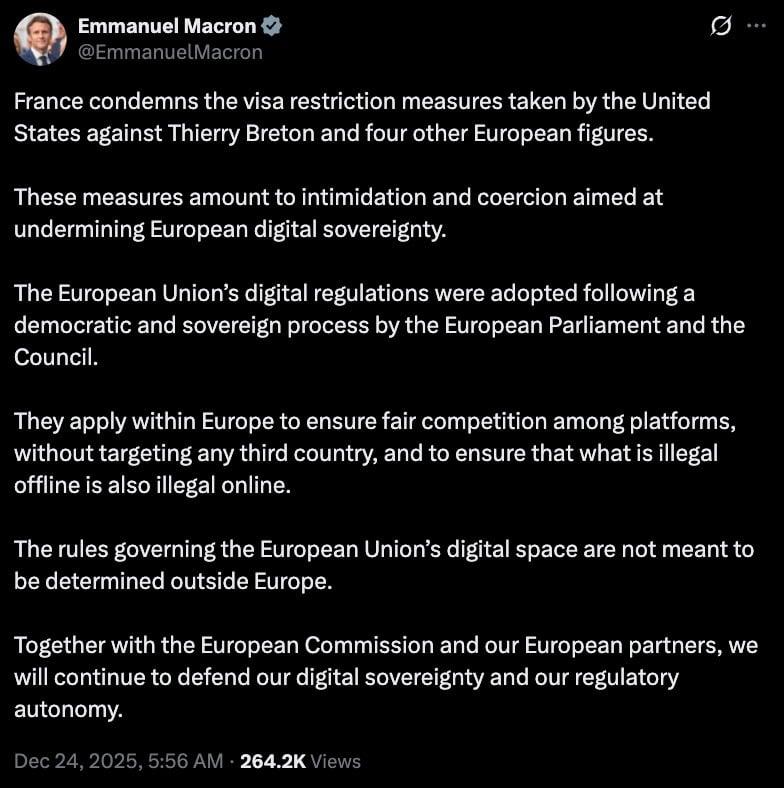
He described the move as “intimidation and coercion aimed at undermining European digital sovereignty,” presenting the visa restrictions as an attempt to pressure European institutions over their digital rules.
Macron added: “The European Union’s digital regulations were adopted following a democratic and sovereign process by the European Parliament and the Council.”
Macron further argued that Europe’s digital regime is internally focused and jurisdictionally bounded. He stated that the rules “apply within Europe to ensure fair competition among platforms, without targeting any third country, and to ensure that what is illegal offline is also illegal online.”
He then ironically drew a line against outside influence, saying “the rules governing the European Union’s digital space are not meant to be determined outside Europe.”
Macron concluded by pledging that France, “together with the European Commission and our European partners,” will continue “to defend our digital sovereignty and our regulatory autonomy.”
That defense of regulatory autonomy arrives as France faces growing scrutiny for aggressive enforcement actions that extend well beyond platform compliance.
French authorities arrested Telegram founder Pavel Durov in connection with content posted by Telegram users, a move widely viewed as holding an individual executive responsible for third-party speech.
Placed alongside Macron’s condemnation of US visa restrictions, the arrest reveals a widening gap between Europe’s stated claims of democratic process and the practical effects of its enforcement choices.