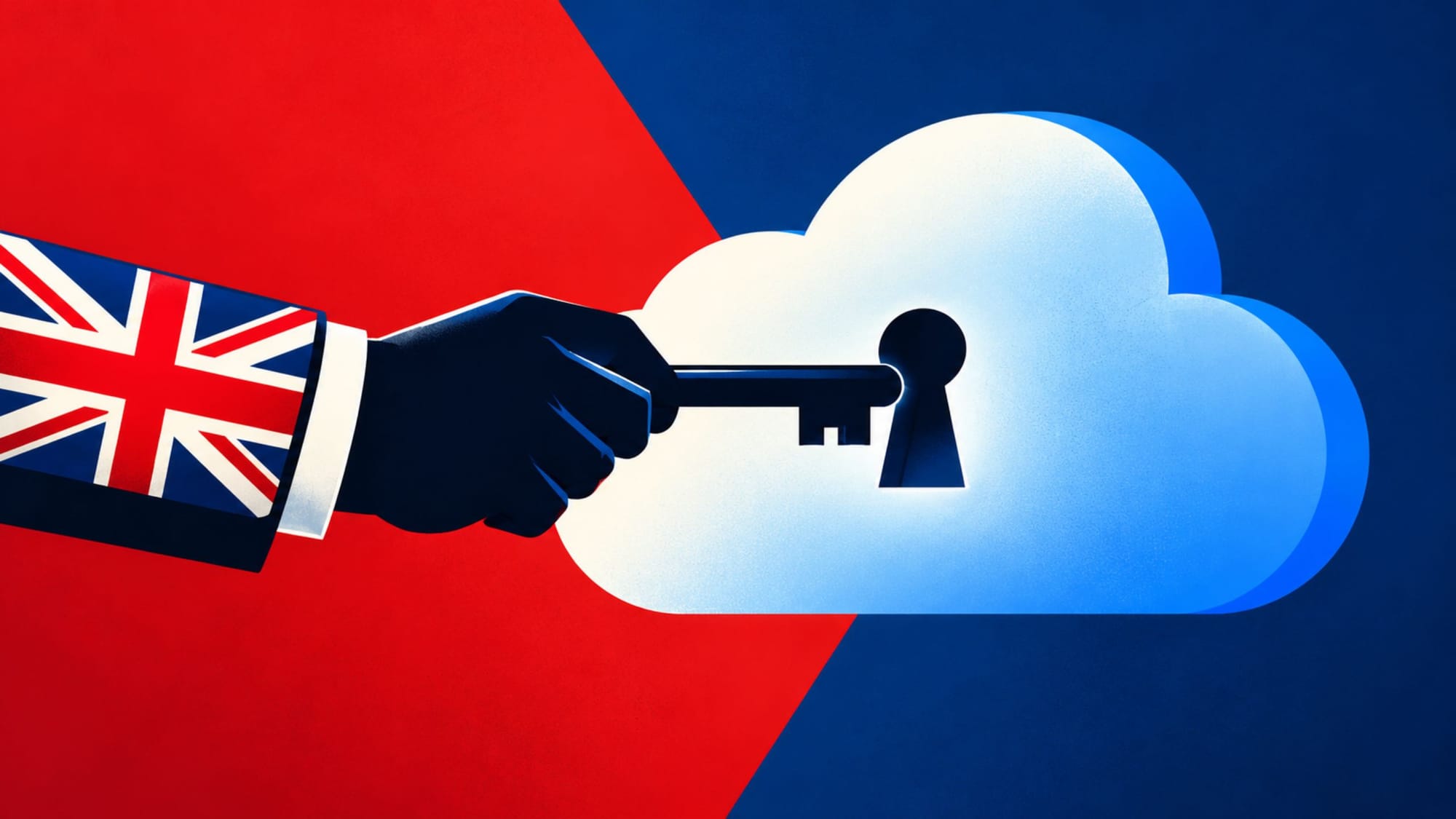
The New Statesman is reporting that a White House security official expects the UK to use the backdoor it wants to build into Apple's iCloud – through a secret court order – to spy on the Trump administration and Reform UK leader Nigel Farage.
The magazine said it had seen a message sent in September from the official to a colleague, which reads: "The UK is making another attempt to put a backdoor on iCloud. This time by their secret court. They're going to lean on a court order to justify it. They will use this back door to spy on the administration and Nigel Farage."
The report does not show that anyone has actually been spied on in this way, and it's obviously alarmist, but the message reveals the fear is present inside the US administration, so at least people are aware of what the UK is doing to undermine privacy.
It is also a perfect example of how a backdoor built to catch criminals is actually a tool that can be used by whoever happens to have it at their disposal, including against political opponents – and allies.
The UK is keeping the order so secret that Apple was able to brief the US Vice President about it - but not the US Congress.
The UK first tried to get Apple to give it access to all iCloud users' encrypted cloud backups around the world, through the country's Investigatory Powers Act, and a secret technical capability notice (TCN). The order was later changed to cover only UK users, after the US put pressure on its ally.
Apple never built that backdoor, at least as far as we know. Instead, it withdrew its strongest encryption, Advanced Data Protection, from UK users, and new UK users are still unable to turn it on.
Apple has also said that it has "never built a backdoor or master key to any of our products and services and never will."
In June, House Judiciary Chairman Jim Jordan wrote to UK Home Secretary Shabana Mahmood to warn that if reports about the UK order were true, it would mean that the country is building "backdoors into their encrypted services."
Jordan said that would put at risk the security of US citizens' data.
In September, Democratic Senator Ron Wyden and Republican Representative Warren Davidson wrote to the UK’s Investigatory Powers Tribunal to express their concern over the secret order, saying that the UK was being “wholly inappropriate” in preventing Apple from discussing the issue with US Congress.
"The U.K. government's unprecedented demands for secrecy in this matter undermine democratic governance in both the United States and the U.K., and needlessly strain the relationship between our two nations," the two congressmen wrote.
Weakening encryption in consumer software, the letter said, “introduces critical vulnerabilities that can be exploited by hostile foreign actors.”
Apple went to the Investigatory Powers Tribunal (IPT), which hears complaints about surveillance, to try to have the UK order revoked. Privacy International and Liberty have a separate challenge before the same court.
The UK government will neither confirm nor deny that the order exists. But Ben Jaffey KC, who represents Privacy International and Liberty, told the tribunal that "the horse has long bolted."
"The fact that Apple even needed to ask permission confirms there is a TCN," Jaffey said.
Meanwhile, Neil Sheldon KC, acting for the government, said the home secretary's position was "neither irrational nor unsupported by evidence."
In February 2025, Reclaim The Net reported that the UK was trying to force Apple to give it access to all iCloud users' encrypted cloud backups around the world, and that Apple had in the meantime pulled its strongest encryption, Advanced Data Protection, from UK users.
In September 2025, we reported that Farage had told the US Congress that the UK's Online Safety Act was a threat not only to free speech, but also to encryption.
In June, we reported about Jordan's letter to Mahmood, warning that the UK order could compromise data of US citizens.
A backdoor does not check who is asking to use it, or why – and the officials worried about it being turned on Farage and the Trump administration are essentially describing why nobody should have a backdoor.