The way to control online speech has long been to make money the incentive for self-censorship and to deplatform those who don't comply. One way to achieve this is to keep the majority of the ad revenue generated by creators for the platform.
Rumble CEO Chris Pavlovski is now announcing that his company is about to turn this model on its head, and make it more difficult for the likes of YouTube to police content. Rumble will give creators in its Partner Program up to 90% of the revenue from video ads.
Pavlovski made the announcement on X, saying, "For years, video platforms have taken advantage of creators. On November 1st, we're flipping the script."
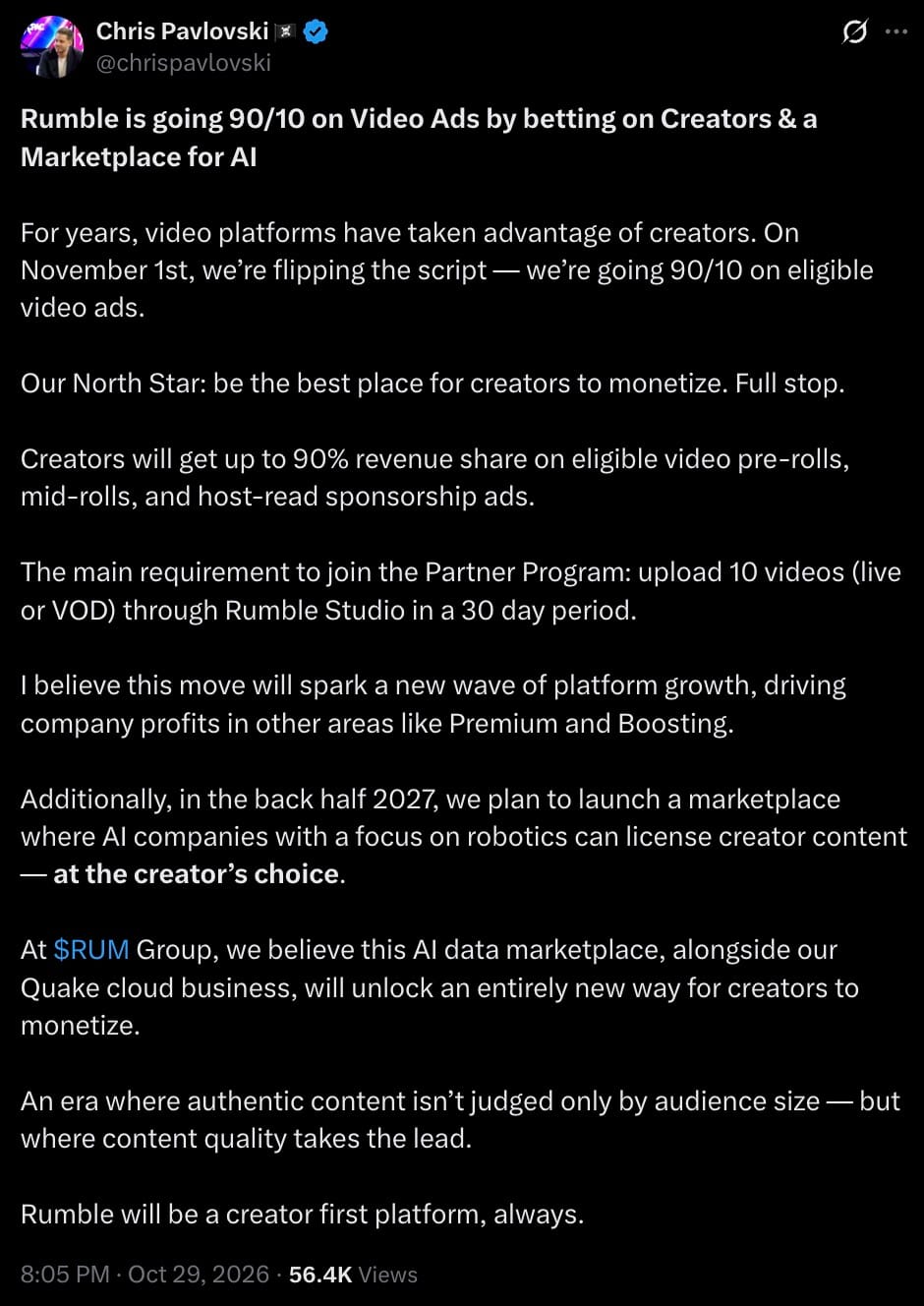
He also revealed that the plan is to launch a marketplace in the second half of 2027, where creators will have the option to license their content.
He also compared Rumble’s offer to YouTube’s: “YouTube’s revenue share will be 55% for video ads. Rumble’s revenue share will be 90% for video ads.”
This is not the only way Rumble is hoping to attract creators from YouTube and other video platforms. The Partner Program page promises that Rumble will never censor, deplatform or shadow ban creators, and they will be able to continue streaming on other platforms at the same time.
Another promise is that there will be no minimums regarding subscribers or watch hours, but a creator will have to stream or upload at least 10 times through Rumble Studio in a 30-day window to qualify. The program is open to both on-demand and live creators, but it is invitation-only, with the company's partnerships team reviewing each request. The terms of the deal are not publicly available, as the company says, "Exact terms are shared one-on-one with approved creators."
Pavlovski has big hopes for the new programs, saying that they, along with Rumble's Quake cloud business, "will unlock an entirely new way for creators to monetize."
The marketplace is still in the future, and for now, many questions remain unanswered, such as what terms will be offered to creators and AI companies, and what those companies will be allowed to do with the licensed footage. Another question is what happens to people who are filmed in a creator's video without their consent, such as those who are in the background, or the creator's family and friends.
Pavlovski says, "the creator's choice" will be what decides whether a video is licensed or not, but this clearly only covers the creator, and not other individuals who may be in the video.
As for the Partner Program, Pavlovski expects it to drive profits "in other areas like Premium and Boosting." And he is encouraging creators to handle their own sponsorship deals, saying, "Why would any creator use an agency? Keep that money in your pocket."
Rumble has been in the news before for its pro-free speech policies, such as pulling out of France in 2022 rather than comply with a government order to remove certain videos, and then restoring access after a court said the government had no authority to make such a demand.
The company also sued a Brazilian Supreme Court justice, Alexandre de Moraes, in a US court for his censorship orders.
In June 2026, Rumble renamed its cloud business to Quake after acquiring Northern Data and its GPUs.
Rumble also launched Rumble Wallet, a payment service based on Tether, to enable creators to receive their earnings in cryptocurrency, bypassing banks and payment processors.
A platform that pays its creators most of the ad revenue, and promises not to cut them off based on their speech, weakens the leverage that Big Tech has over online expression.
However, the AI marketplace is where Rumble will have to prove that it is not only about paying creators more, but also about treating them and their content with the respect that YouTube and others have not shown. Licensing footage of real people to robotics companies is a privacy question as much as a financial one, and the terms of this scheme, still unknown, will decide whether opting in means selling more than one has the right to sell.