Telegram founder Pavel Durov has said Russia’s latest restrictions on the messaging platform reflect a deliberate attempt by the state to steer citizens toward a government-controlled alternative designed for monitoring and content control.
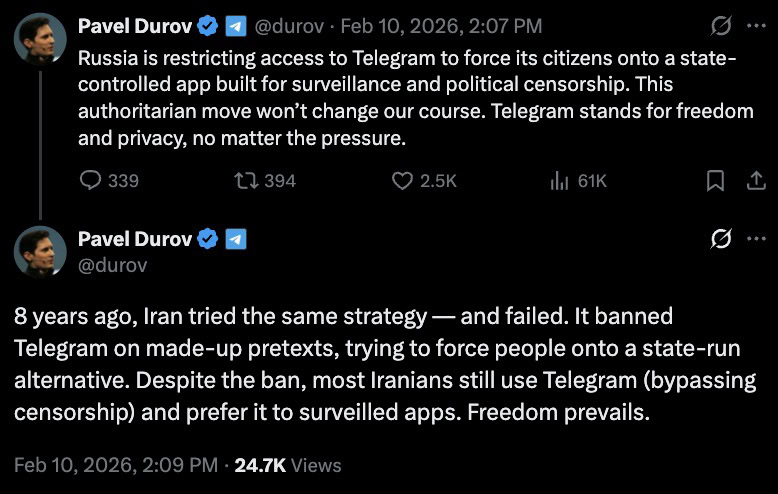
In a public post, Durov stated that “Russia is restricting access to Telegram to force its citizens onto a state-controlled app built for surveillance and political censorship. This authoritarian move won’t change our course. Telegram stands for freedom and privacy, no matter the pressure.”
His remarks were published as Russian regulators prepared to further limit access to the service.
The comments followed reports from Russian media that enforcement actions were imminent.
According to the RBC news service, the federal communications regulator Roskomnadzor plans to begin formally restricting Telegram this week, citing unnamed individuals familiar with the matter.
The same outlet reported that technical measures to slow the service had already begun.
Durov placed the Russian effort within a broader pattern of state behavior, pointing to earlier attempts by Iranian authorities to marginalize the platform. “8 years ago, Iran tried the same strategy — and failed. It banned Telegram on made-up pretexts, trying to force people onto a state-run alternative,” he wrote.
“Despite the ban, most Iranians still use Telegram (bypassing censorship) and prefer it to surveilled apps. Freedom prevails.”
Russian policy now pairs access restrictions with the promotion of Max, a state-run “super-app” modeled on China’s WeChat. Max combines messaging with government services, document storage, banking tools, and other public and commercial functions.
By design, this consolidation routes communications and personal data through infrastructure overseen by the state, aligning convenience with administrative control.
Pressure on Telegram has been building since late 2025, when authorities began selectively limiting features such as voice and video calls. The approach mirrors earlier actions taken against other foreign platforms.
In November, Russia moved toward fully blocking WhatsApp, owned by Meta, following months of service degradation. Regulators alleged the app was used to organize terrorist attacks and recruit participants, claims cited as grounds for enforcement.
Other services have already been removed or curtailed. Russian authorities have banned Facebook, Instagram, and X, while limiting access to YouTube.
These measures intensified after President Vladimir Putin ordered the 2022 invasion of Ukraine, as the government moved to narrow the range of information channels available to the public.