
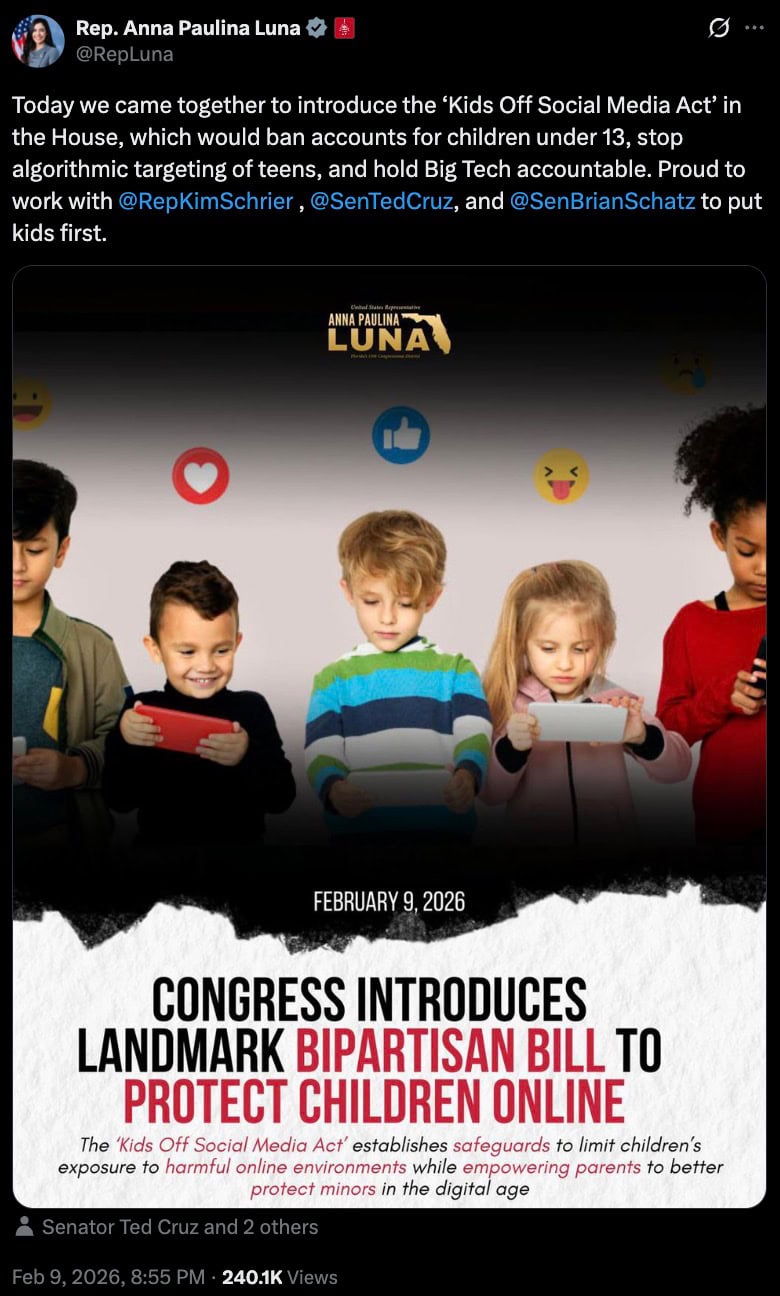
Congress is once again stepping into the role of digital caretaker, this time through the Kids Off Social Media Act, with a proposal from Rep. Anna Paulina Luna that seeks to impose federal rules on how young people interact with the world.
The house companion bill (to go along with the senate bill) attempts to set national limits on who can hold social media accounts, how platforms may structure their systems, and what kinds of data they are allowed to use when dealing with children and teenagers.
Framed as a response to growing parental concern, the legislation reflects a broader push to regulate online spaces through age-based access and design mandates rather than direct content rules.
The proposal promises restraint while quietly expanding Washington’s reach into the architecture of online speech. Backers of the bill will insist it targets corporate behavior rather than expression itself. The bill’s mechanics tell a more complicated story.
The bill is the result of a brief but telling legislative evolution. Early versions circulated in 2024 were framed as extensions of existing child privacy rules rather than participation bans. Those drafts focused on limiting data collection, restricting targeted advertising to minors, and discouraging algorithmic amplification, while avoiding hard access restrictions or explicit age enforcement mandates.
That posture shifted as the bill gained bipartisan backing. By late 2024, lawmakers increasingly treated social media as an inherently unsafe environment for children rather than a service in need of reform. When the bill was reintroduced in January 2025, it reflected that change. The new version imposed a categorical ban on accounts for users under 13, restricted recommendation systems for users under 17, and strengthened enforcement through the Federal Trade Commission and state attorneys general, with Senate sponsorship led by Ted Cruz and Brian Schatz.
What the Bill Actually Does
Under the act, anyone under 13 would be barred from holding a social media account. Platforms would be required to terminate those accounts and erase associated personal data.
For users under 17, companies would be prohibited from using personal data to drive recommendation systems, including ranked feeds and automated content promotion.
The measure defines social media narrowly enough to spare email, video conferencing, and educational tools, while capturing public-facing platforms built around user-generated content. That line matters because it places algorithmic speech spaces under federal design rules while leaving other digital services untouched.
Luna framed the bill as a response to parental frustration. “Protecting kids online is not a partisan issue,” she said. “Parents across America are sounding the alarm about the real harms social media is causing—from anxiety and depression to exposure to dangerous content.”
She added, “This bipartisan coalition reflects families nationwide who have been asking for help. The Kids Off Social Media Act is about putting children’s safety first and holding Big Tech accountable.”
The House version is co-led by Rep. Kim Schrier, with a Senate companion introduced by Ted Cruz and Brian Schatz. Lawmakers highlighted the bipartisan lineup as proof that child safety remains one of the few issues capable of cutting across party lines.
Schools Become Enforcement Zones
The bill also extends to public education. Schools receiving E-Rate subsidies would be required to block access to social media platforms on school-owned devices and networks. Filtering technology and formal internet safety policies would become mandatory, with repayment obligations hanging over districts that fail to demonstrate a good-faith effort.
This turns federally subsidized connectivity into a compliance lever. Access decisions would be enforced at the network level, not by content review but by outright exclusion.
Enforcement authority would rest with the Federal Trade Commission, alongside state attorneys general empowered to bring civil actions. That structure mirrors recent tech statutes that rely on overlapping federal and state pressure, nudging companies toward nationwide uniformity to reduce legal exposure.
Cruz framed the bill in familiar protective terms. “Every parent I know is concerned about the online threats to kids—from predators to videos promoting self-harm, risky behavior, or low self-esteem,” he said. “The Kids Off Social Media Act addresses these issues by supporting families and empowering educators to better manage safe learning environments.”
Health Claims Mixed With Platform Design
Schrier tied the proposal directly to pediatric outcomes:
“As a pediatrician and a mom, I’m very worried about the impacts that screen time and social media are having on this generation. We’re seeing sleep deprivation, inattentiveness, impaired social skills, and increased rates of depression and anxiety that experts in the field link to social media use. Social media companies are not properly regulating their platforms and are pushing harmful content on our kids that they know is detrimental. They’re purposely designing their platforms to make them more addictive and keep kids scrolling so they can rake in more profits. Our kids are not for sale. That’s why I’m proud to lead this bipartisan legislation to set commonsense safety measures on social media use and protect our children.”
Schatz dispensed with nuance:
“There is no good reason for a nine-year-old to be on Instagram or Snapchat. The growing evidence is clear: social media is making kids more depressed, more anxious, and more suicidal. Yet tech companies refuse to do anything about it because it would hurt their bottom line. This is an urgent health crisis, and Congress must act with the boldness and urgency it demands. Protecting kids online is not a partisan issue, and our bipartisan coalition — which includes several parents of kids and teenagers — represents the millions of parents across the country who’ve long been asking for help.”
The quotes sketch a clear political strategy. Focus on harm, emphasize addiction, and present access limits as a form of public health intervention. The debate over speech is left to the fine print.
The Age Question Nobody Wants to Name
That fine print contains an unresolved problem. The bill does not explicitly require a national age verification system or a formal digital credential. But it also does not explain how platforms are supposed to tell who is 12, 16, or 18 in a way that can survive legal scrutiny.
Right now, most platforms rely on self-attestation. Users enter a birthdate and move on. That approach collapses once liability attaches to age thresholds, data deletion mandates, and algorithmic restrictions. Once penalties are real, companies need proof.
This pushes platforms toward age verification systems with audit trails. That can involve third-party identity brokers, document checks, biometric estimation, or device-linked credentials. Each option introduces a more persistent identity layer, even if the stated purpose remains child protection.
Anonymous or pseudonymous participation becomes harder to maintain when access depends on verified attributes. The pressure comes from the enforcement structure surrounding it.
This pattern fits neatly into a wider policy trend. Financial regulation, online safety proposals, and fraud rules already push toward stronger identity requirements. Once platforms build age verification systems for minors, the same infrastructure can be extended to other objectives. The compliance paper trail becomes a resource regulators can later tap.
History suggests companies will choose standardized systems that reduce legal risk, even if they increase data collection. From a speech perspective, that is the core concern. A law framed around protecting children can still accelerate a shift toward credentialed participation.
The Kids Off Social Media Act may not mandate digital identification by name. Its logic points in that direction all the same.