A confrontation now unfolding between the UK’s communications regulator and a US-based website is ultimately less about the merits of certain online content than about jurisdiction.
At stake is whether British authorities can fine and disrupt a company that operates entirely in the US and under US law for speech that is legal in the United States and protected by the First Amendment.
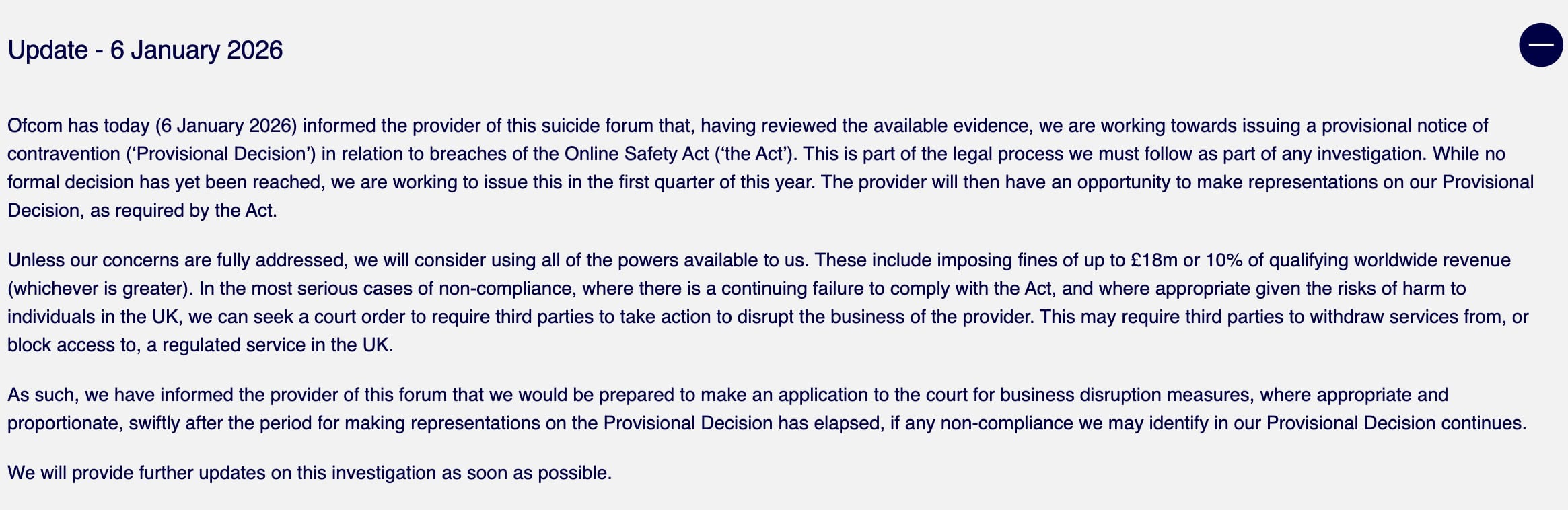
On January 6, Ofcom disclosed that it had issued a “provisional notice of contravention” under the controversial Online Safety Act to an unnamed suicide discussion forum, suggesting a path toward financial penalties and court-ordered service blockades.
More: UK Speech Regulator Ofcom Claims First Amendment Doesn’t Protect Americans From Its Censorship Law
Attorney Preston Byrne has stated that the forum is wholly owned and operated from the United States and has already blocked UK users.
The regulator framed its action as part of a compliance process under the UK’s censorship law, the Online Safety Act, citing alleged failures to respond to statutory information requests and to maintain required internal documentation related to illegal content risk assessments.
Ofcom said it is preparing a formal decision in the first quarter of the year and warned that unresolved concerns could lead to penalties of up to £18 million or 10 percent of global revenue, whichever is higher.
More significantly, Ofcom stated that it is prepared to ask courts to compel “third parties to withdraw services from, or block access to, a regulated service in the UK.”
That would allow the regulator to pressure internet service providers, search engines, or other intermediaries into cutting off access to a site, even if the site itself has no UK presence and the UK has no jurisdiction.
What makes the case unusual is that the platform has already implemented UK IP blocking.
More: 4chan and Kiwi Farms Tell Ofcom It Can’t Censor and Run From Lawsuits
The dispute is not about harm prevention but about whether UK regulators can enforce domestic speech rules against foreign speakers who are outside their legal reach.
Byrne said that the site “will not entertain foreign censorship codes that violate rights secured by the Constitution.”
In a separate post on X, Byrne described the case as politically driven, writing that “the entire UK censorship-industrial complex needs a ‘win’ for the Act so badly (having not had one in a year), they’ll manufacture one.”
The Online Safety Act says that Ofcom has wide latitude to regulate user-to-user platforms, but Ofcom seems to think it has power beyond the UK border.