
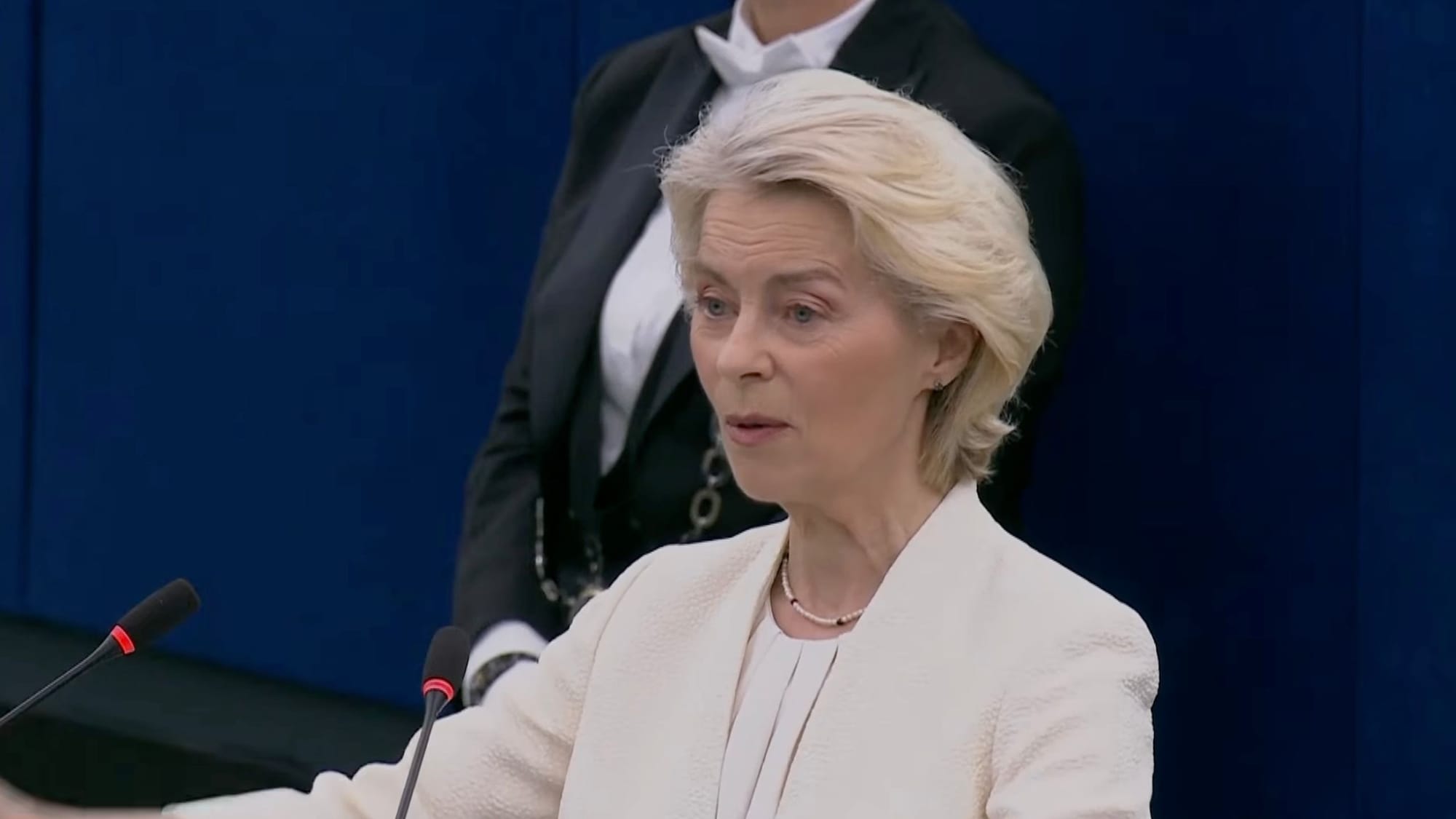
European Commission President Ursula von der Leyen, French President Emmanuel Macron, Spanish Prime Minister Pedro Sánchez, Australian Prime Minister Anthony Albanese, and UNICEF Executive Director Catherine Russell are among the figures promoting a new wave of online restrictions under the banner of child safety.
Ursula Von der Leyen was the most explicit, using the European Commission's proposal for a KIDS Act to explain how the EU plans to "protect" children online. The proposal was first presented last week, and the President of the European Commission has now told the UN gathering that "92% of Europeans say we should engage more in protecting children online."
The KIDS Act, she went on to say, will make sure that "no social media under 13. No personal accounts under 15. That means, from 13 until a child turns 15, only mini accounts set up and supervised by parents, with limited features and time restriction - 60 minutes a day, but the parents can reduce this time."
What it is about is building an infrastructure that requires every internet user to prove their age before they can participate in online life. This is the only way to enforce rules that say children should not be on social media under a certain age, or that their accounts must be controlled by parents up to a certain age, or that AI providers must know if a user is a child before they are allowed to use their services.
This is the essence of the proposal, and the only way to implement it is to build a system that can accurately identify the age of every internet user.
Macron, meanwhile, wants to make sure that the same rules are applied to AI, and that the lesson has been learned from what happened with social networks - apparently, that it took too long to "protect" children from them.
"We shall learn from what happened with the social networks and move much more quickly" on AI, Macron said, adding that AI providers must be made to "demonstrate the benefits it claims and to allow for an independent assessment of its risks, taking into account the child's age, the intended use and the context."
Macron praised Australia's law that bans under-16s from social media, Spain's work on age verification, and the KIDS Act, and said the goal is to come up with a strategy at the EU level, and then bring in "all like-minded countries."
The next step, he said, will be the Paris Peace Forum in November.
The push to establish age verification as a tool to "protect children" online is picking up pace, with several world leaders now joining in to promote the idea, and seeking to export it globally.
Spain's Sanchez, who spoke of a "small group of techno-oligarchs" defining values and business models, and tied the use of AI to a host of ills, from abuse to loss of privacy, and anxiety, also praised his country's work on age verification, based on EU's digital ID, and called for "a national, regional global response."
He also noted that a year ago, setting a minimum age for social media use was "unthinkable" and is now "on the table."
Australia's Albanese, meanwhile, said his country has already banned those under 16 from social media and given more powers to the eSafety Commissioner, and will by the end of the year come up with standards for AI.
UNICEF Executive Director Catherine Russell said that the UN children's agency, which is behind the coalition formed in Geneva in July that organized the New York event, wants to make sure AI is designed with safety and children's rights at its core.
And while the phrase "think of the children" has been abused by many to push for all sorts of online restrictions, one thing is certain - the latest drive, supported by the likes of European Commission President Ursula von der Leyen, French President Emmanuel Macron, and others, is not about protecting childhood at all.
But the common thread that runs through all the proposals and ideas presented is the need to build an age check infrastructure that will be used to enforce all of the above.
And once it is built, it will be used for everything, and the "think of the children" excuse will be long forgotten.