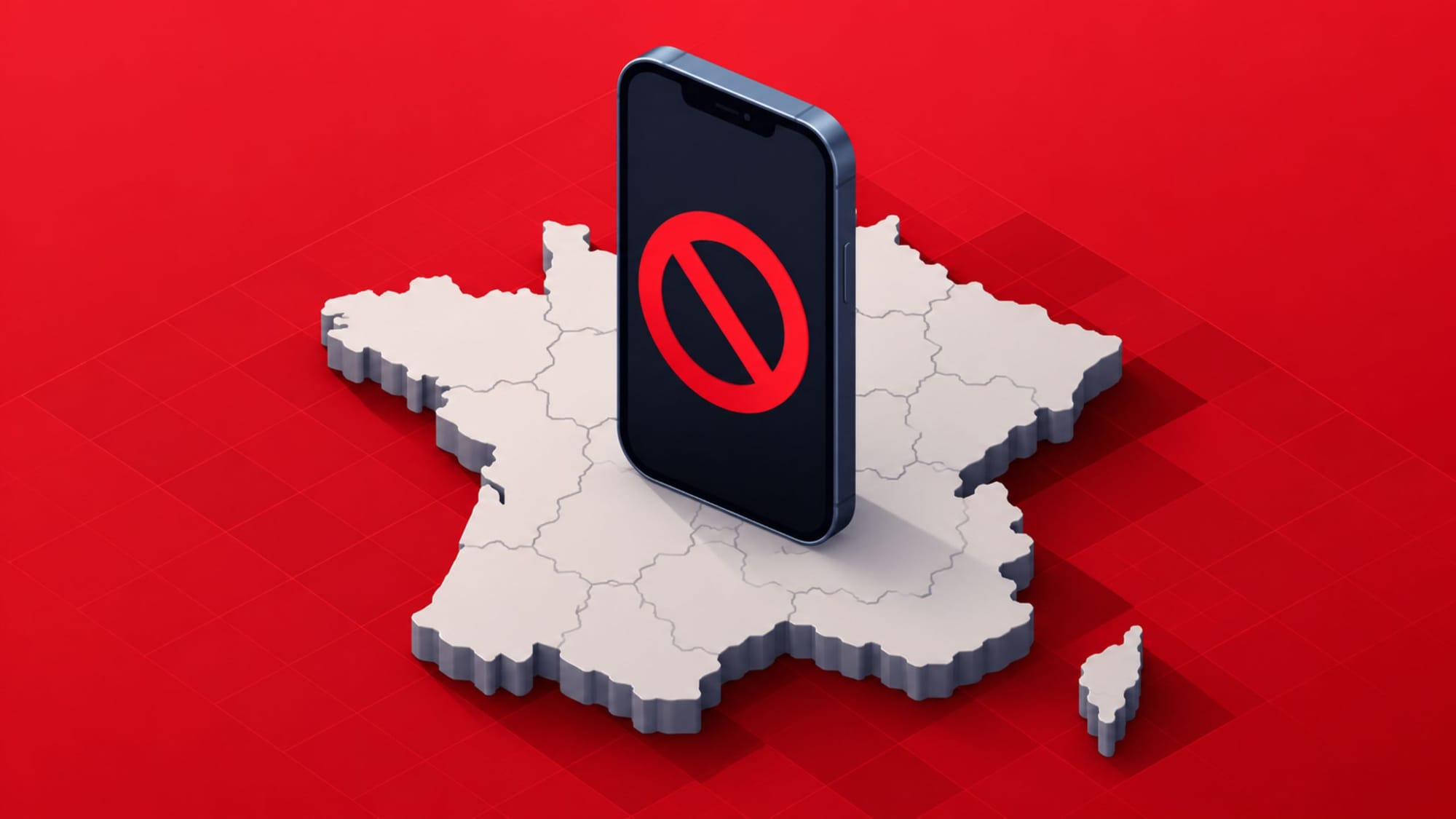
On October 22, 2026, France’s Prime Minister Sébastien Lecornu wrote to the CEOs of the country’s four mobile operators, asking them to be prepared to block access to four social media platforms for several hours.
The letter from Prime Minister Sébastien Lecornu, dated October 22, 2026, named Snapchat, TikTok and Instagram, and asked that these be blocked by DNS filtering, which stops the names of the sites from resolving. X was added to the list after the letter went out.
Blast has seen the letter and the minutes of the meeting that followed.
“Have the ability to temporarily suspend access to these services in the event of a recurrence of urban violence,” Lecornu wrote, referring to the riots that erupted on October 17 and 18.
The reason, he explained, was the previous round of protests, when, according to him, social networks played “a decisive role not only in the crystallization and virality of illicit calls to action but also as levers for the operational coordination of violence.”
He then listed “the organization of looting, exchanges about targets, the movement of groups or the positions of law enforcement” as examples of this.
According to the minutes of the meeting, the block was to be switched on at 2 pm on Saturday, October 24, and the operators put their staff on call.
The order was not given. Instead, some 410,000 people (by the Interior Ministry’s count) or 800,000 (by the CGT union’s) protested on October 24, while 70,000 police and gendarmes were deployed, making nearly 1,000 arrests.
Blast writes that it was unable to determine if the government planned to block the four platforms on all internet networks, or just the mobile ones.
“Cutting off social networks means depriving citizens of their eyes and their voice at the precise moment when those in power have the most interest in nothing being seen,” the report said.
It was not used. But it was planned, with a clear goal, at a specific time, and with personnel put on call.
It’s not the fact that the French government wanted to block social media that is the most interesting and telling detail to emerge from the minutes of a meeting.
Instead, it’s the fact that the government wanted the block to be limited to mobile phones, and to certain areas – and that the telecom operators told them they could not do that, at least not at short notice.
The meeting was a 70-minute videoconference that took place on October 23. The government’s general secretariat, the Prime Minister’s office, the Directorate General for Enterprises, and the legal departments of the four operators took part.
According to the tech site Clubic, the cut was to hit mobile connections (4G and 5G) first, and spare home fiber and ADSL as far as possible, and the Prime Minister’s office wanted a measure “as targeted as possible.”
Clubic, citing the minutes, said that Orange noted that, “it is often enough to change the DNS server in your phone’s settings to get the full directory back.”
The operators asked for an act that was signed, dated, reasoned and published; Orange insisted on a formal order. The government, on the other hand, said that a private instruction to each operator would do, with nothing in the official journal, and planned a press release about 30 minutes before the block went live, without the technical details.
Interior Minister Laurent Nuñez said this week that “social networks are becoming a real problem” and that the government had the option of “suspending the use of the networks.”
The French government has tried to block social media platforms before – and failed.
During riots in New Caledonia in May 2024, Gabriel Attal, then prime minister, blocked TikTok there.
On April 1, 2025, the Council of State, the country’s highest administrative court, ruled the block illegal. The court said the block “was illegal because it caused a disproportionate infringement of the rights and freedoms” of those who challenged it, and that the Prime Minister had “decided on a total interruption of the service for an indefinite period linked solely to the persistence of the disorder.”
The court’s rule: the administrative authority “may not decide, outside the cases provided for by law, to interrupt access to such a service. It may however resort to such a measure, in exceptional circumstances, if it is indispensable to meet the needs of the moment.”
The court rejected the argument that the block had no legal basis: the exceptional-circumstances power “results from well-established case law, constituting, therefore, a sufficiently foreseeable legal basis.”
“During riots, we must be able to temporarily and selectively block access to certain platforms to stop the herd effect,” Attal wrote on X, and then told RTL that he wanted “a temporary, targeted block on the territories where the riots take place.”
When the broadcaster reminded him that the state had been condemned for the 2024 block of TikTok in New Caledonia, he said, “Temporarily. The State Council said that social networks could be blocked.”
Nuñez on the ruling: “The Conseil d’État in 2025 considered that, in principle, nothing prohibited it under exceptional circumstances, with very strict conditions, and it is something that has obviously not escaped me.”
In other words, the legal brakes on this are being tested, not removed. And a list of conditions is something that a government can learn to meet.
Internet Society’s Pulse blog has an article by policy expert Saadia Azim, who warns against treating a shutdown as a single technical condition.
“Each condition calls for different resilience,” she said.
The right question to ask, according to her, is not whether you have internet, but which parts of the communications stack still work. And the right tool to “beat” the shutdown depends on the answer.
The lightest form of shutdown is a block on particular platforms, done by DNS, IP address or domain name filtering – but the rest of the internet works, and a VPN or Tor can get you around it. This is the kind of shutdown that France, for example, planned.
In this scenario, a user can still access the open internet, but is blocked from reaching specific sites or services. Access Now counted a record 94 such incidents in 40 countries in 2025, up from 77 in 37 countries the year before. Facebook and WhatsApp were the most blocked.
The next level up is when the censor goes after the tools that can help users circumvent the first level of blocking, i.e., the VPNs and Tor, by detecting and killing their traffic. This is done by identifying the “shape” of this traffic and blocking it.
To counter this, users need tools that can make their traffic look like something else. But even then, the game of cat and mouse doesn’t have to end, as the censor can then try to identify the new traffic shape and block that as well.
Access Now’s #KeepItOn campaign lead Felicia Anthonio said, “In the absence of internet access, anything that enables you to communicate is a lifeline.”
There’s also the heavier kind of cut.
This includes turning off mobile data in one area – in which case, if you can move to a place where home broadband or a friend’s Wi-Fi is available, you’re good to go.
In Russia, the number of regional mobile shutdowns grew from 69 in May 2025 to at least 2,099 in July of the same year, according to the monitoring project Na Svyazi, as reported by the independent Russian website Meduza.
In central Moscow, mobile internet was out for nearly three weeks in March 2026. And since September 2025, Russia has been using a list of approved services during mobile shutdowns, starting with 57 websites, including the state services portal, VK and Yandex. Everything else is cut. Russian researchers found that in this mode, no VPN works, regardless of the protocol it uses, unless its server is on approved address space.
Then there is the total blackout, where nothing, including home broadband, reaches the internet. The only thing that still works is phones talking directly to each other.
In January 2026, Iran cut the internet for more than 60 hours, as confirmed by data from Cloudflare, and as reported by Access Now. The digital rights group said that the authorities first throttled connections, blocked circumvention tools, and then cut the internet, mobile service, and international calls nationwide on the evening of January 8.
You need to know which of these scenarios you are in before you reach for a tool.
Russia is where VPN protocols go to get tested to destruction – and the ordinary, non-disguised ones have been the first to go. Those are the ones with a “handshake” that is easily recognizable as a VPN connection.
Russia’s censorship infrastructure is built around TSPU boxes installed at every internet provider under a 2019 law, and controlled by the regulator Roskomnadzor. A 2022 study by Diwen Xue and colleagues found blocking “triggered by SNI, IP, and QUIC” and warned that “we fear that the emerging TSPU architecture may become a blueprint for other countries.”
The makers of the Amnezia VPN app also state that WireGuard is “easily recognized by DPI analysis systems, susceptible to blocking.” On the other hand, their own AmneziaWG, which is a version of WireGuard that is made to look like a different protocol, is “not recognised by DPI analysis systems, resistant to blocking.”
This is the vendor’s claim, and we were unable to find any independent testing to confirm this.
Another project, VLESS with Reality, is a version of the VLESS VPN protocol that disguises a connection as an ordinary visit to a real website. The project’s documentation describes Reality as “a modified form of TLS that uses the appearance and handshake characteristics of a target site as camouflage.”
Russia has been catching up with Reality, too: there were first attempts to block it in November 2025, then in February 2026, two home internet providers, Dom.ru and Rostelecom, blocked it, while in May 2026, the authorities started blocking the handshake in Siberia, the Far East, and Moscow. But by September 2026, testers in Moscow and St. Petersburg found that it was working again.
By August 2026, Russia was blocking whole ranges of IP addresses where VPNs are hosted. Mikhail Klimarev of the Internet Protection Society said at the time, “Today they blocked VPNs pretty thoroughly. On a mass scale.”
That’s why, in Russia, the best advice is to have more than one provider, and more than one protocol, to be able to switch when one is blocked.
To fight against internet shutdowns and other forms of online censorship, it’s good to have two VPNs from different companies, at least one of which has the capability to disguise its protocol. And it’s good to know how to switch that protocol before you actually need to do it.
Even running your own VPN server on a rented virtual machine (VPS) is not a foolproof solution. In fact, reports from Russia say that the authorities have been blocking those as well, simply by IP address, in case that address is shared with a VPN service.
Then there are the “free” VPNs – those that appear in the app store of your choice, particularly during a crisis, and offer you their service for free. Needless to say, they are the one to avoid at all costs.
The Tech Transparency Project found that “one in five of the top 100 free virtual private networks in the U.S. App Store during 2024 were surreptitiously owned by Chinese companies” – and that those apps had been downloaded more than 70 million times.
Meanwhile, researchers from Citizen Lab and Arizona State University found three families of VPN providers, with more than 700 million Google Play downloads combined, that shared passwords built into their apps that would “allow an attacker to decrypt the traffic of these providers’ clients”.
Previously, Reclaim The Net reported about Apple removing VPN apps from its store in Russia in 2024 and 2026, and about Russia’s attempt to get Google to remove more than 200 VPN apps from its store in 2025 – only six of which were actually removed.
If the Tor network is blocked, then bridges and pluggable transports can help. This is because a bridge is a Tor entry point that is not publicly listed, while pluggable transports disguise the connection, making it look like an innocuous one.
The Tor Project advises users to try different transports in case the connection is blocked for the first time: obfs4, webtunnel, snowflake, or meek. If none of these work, then the next step is to request a bridge or enter one by hand.
Snowflake is special because it doesn’t need an address in advance, and is particularly useful once you are already cut off from the Tor network. That’s because, as the project’s website explains, “You do not need to obtain bridge addresses in order to use these transports.”
The project has also been working on WebTunnel, which makes the traffic look like ordinary web traffic. While useful, it has its limitations, as in June 2025 the Russian censors began blocking most of the WebTunnel bridges.
How to get that bridge in the first place? The Tor Project has a number of suggestions.
If you are already using the Tor browser, you can find the bridges under Settings, then Connection, then Bridges. If you are not using the browser, you can get the bridges by messaging the Telegram bot @GetBridgesBot, by emailing [email protected] or by visiting bridges.torproject.org.
If the Tor website itself is blocked, then the browser can be downloaded via the Telegram bot @gettor_bot, or by emailing [email protected].
On Android, you can use Tor’s own Tor Browser for browsing, and Orbot for everything else. On an iPhone, there is no Tor Browser – and the app that is recommended instead has some significant limits to its functionality.
Orbot, meanwhile, is made by the Guardian Project and routes other apps through Tor. The app’s description calls it “your trusted connection for Tor on Android and iOS.” If a connection attempt fails, Orbot advises users to hit its Ask Tor button – which refreshes the bridges – and then try all the combinations again.
The Tor Project’s own page on the matter states that “there is no Tor Browser for iOS” – but recommends an app called Onion Browser instead, which it describes as open source, using Tor routing, and developed “by someone who works closely with the Tor Project.”
The same page also warns that Apple’s WebKit “prevents Onion Browser from having the same privacy protections as Tor Browser.”
Orbot, meanwhile, is limited on iPhones by a memory cap that Apple has placed on VPN-type apps. This makes the app unstable.
To keep Signal working, you should go into the app’s settings today, find the censorship circumvention switch – and save some proxy links from people you trust.
For those who don’t know, the switch is in Signal Settings, Privacy, Advanced, Censorship circumvention, on both Android and iPhone. While Signal connects normally, this is greyed out, and the app lets you know that “censorship circumvention is not necessary; you are already connected to the Signal service.”
Another thing that can be done is to use proxies run by volunteers. On Android, go to Signal Settings, Data and Storage, Use proxy, while on iPhone, go to Signal Settings, Privacy, Advanced, Proxy. There is no proxy support on the desktop app.
“Signal Android and Signal iOS apps are registered to handle links from the signal.tube domain so they can automatically configure proxy support when you tap on a link from any other app,” Signal says, and advises users to save links from people they trust privately.
The security researcher who writes for the reversemode blog in January 2026 said they had found that “it is possible to implement feasible Adversary-in-The-Middle attacks on Signal for iOS and Android, under specific circumstances.”
The researcher noted that the attack doesn’t affect the E2EE layer, and that the resources required to pull it off are “limited to nation-states.”
“As a result, high-value targets or individuals in certain authoritarian countries are the most likely to be targeted, while the vast majority of users face minimal risk,” the researcher said.
When the internet is completely down, phones can still talk to each other – and that is when apps like Bitchat, that enable this type of communication, come into their own. Bitchat does this by passing messages from phone to phone over Bluetooth, and every time a government cuts off the internet, people turn to it.
In Nepal, during youth protests in September 2025 that were sparked by corruption and a social media ban, Bitchat downloads went from fewer than 3,344 one week to 48,781 on Monday, September 8, according to charts posted by a Bitchat developer.
In January 2026, when the authorities in Uganda “cut internet access and limited mobile services across the country,” Reuters reported that Bitchat had “more than 28,000 downloads this year, according to research firm Apptopia.” The opposition leader Bobi Wine posted: “HAVE YOU DOWNLOADED BITCHAT YET?”
By April 2026, Apple had removed it from the Chinese App Store.
In July, India’s Home Ministry cybercrime unit gave GitHub three hours to take down Bitchat’s code, saying it “significantly impedes lawful interception, attribution, and investigation.” But the code remained available.
On October 3, the IT ministry ordered Apple to remove Bitchat from its App Store, and the US giant obeyed.
The app was also unavailable on Google Play in India.
Those who already have it installed can still use it, and Bitchat developers are working to make it harder for governments to prevent people from installing it in the first place. On July 28, 2026 they added the possibility of passing the Android app from one phone to another using a Wi-Fi hotspot or Nearby Share.
You can keep on talking, but you won’t be able to hide. That’s the trade-off users of Bitchat, a mesh messaging app, are making, if they are aware of the app’s own caveats.
When it first launched, Bitchat shipped with a warning that said its security had not been reviewed and should not be relied on. The app’s own documents now say that anyone listening in on the Bluetooth chatter that is at its core can tell a Bitchat phone is in use and follow it around – the same kind of data that the police are now installing sensors to capture, as we recently reported in the context of phones broadcasting their owners’ names.
Bitchat’s whitepaper now says that “Metadata is the weakest part of this design, and the peer ID does not help.”
“Unlinkable presence is not a property this protocol currently provides,” the paper further states. And neither is the ability to hide the fact that the app is in use: “the fixed service UUID makes any bitchat device detectable as such by a passive scanner. A receiver in radio range can therefore recognise a specific device across sessions and locations, and detect that the app is in use at all.”
This is not the first time that mesh apps have been promoted as a solution to communication problems that come up during protests and civil unrests. In 2019, Bridgefy was used in Hong Kong and the number of its downloads grew nearly 4,000 percent in two months.
In 2020, researchers at Royal Holloway, University of London, led by Martin Albrecht, found that “Thus, if protesters rely on Bridgefy, an adversary can produce social graphs about them, read their messages, impersonate anyone to anyone and shut down the entire network with a single maliciously crafted message.”
One phone is a brick. For mesh networking to work, a number of people must be using the same app – and you should make sure that your group is all on the same one before the internet goes down, and test it with them while you are still online.
It makes little sense to discover an app once the internet is gone, as Saadia Azim, writing on the Internet Society’s Pulse blog, put it: “Discovering a mesh app only after the network needed to download it has disappeared defeats the purpose.”
Briar, which is open source and has been audited by the security firm Cure53 in 2017, allows messages to be passed only between people who have added each other as contacts, and not through strangers’ phones.
Briar users can sync messages via Bluetooth, Wi-Fi or memory cards, keeping the information flowing even if the internet is down – and if it is up, they can use the Tor network to protect themselves and their relationships from surveillance. However, it is not available on the iPhone, and the makers say that an iOS version is highly unlikely.
Meanwhile, Meshtastic uses small LoRa radios, paired with a phone, that pass messages between each other. The range is much bigger than that of a phone, and the devices can be used in backcountry or in emergency situations.
The project’s documentation describes “inexpensive LoRa” radios “as a long range off-grid communication platform in areas without existing or reliable communications infrastructure” – and that can cover “several kilometers.”
In the end, the only way to be sure that an app will work for you in a pinch is to get your own group on the same app now, and test it offline.
This time, the plan was not implemented, but those behind it are not giving up. And they don’t have to – because the plan failed on logistics, not on principle.
The idea of switching off social networks was not dismissed as unacceptable or illegal. Instead, the French telecoms operators who were to carry out the task said they could not do it for technical reasons: they could not switch them off in certain areas and at short notice, and make sure that only mobile phones were affected.
The French government did draft the letter, and did hold the meeting with the internet service providers, and did hear their objections. Next time, the government may be better prepared to address these issues.
While people who set up VPNs and alternative DNS services now may lose an evening, those who don’t may eventually lose the ability to do it at all.