Russian authorities have now carried their campaign against encrypted communication to its logical endpoint.
On Wednesday afternoon, access to WhatsApp collapsed nationwide after regulators removed the service from the state’s official internet registry, a technical directory that determines how providers route and resolve online traffic.
That act has concrete consequences. Internet service providers rely on Roskomnadzor’s registry to manage lawful routing inside Russia. When a platform is deleted from that system, domain resolution begins to fail and connections break down.
For ordinary users, the app simply stops working.
Until recently, WhatsApp had at least 100M users in Russia. Over the past year, authorities had gradually degraded the service under what were described as “partial restrictions.”
Voice calls have reportedly become unreliable. By December, Russian media reported that WhatsApp traffic speeds had been cut by 70 per cent to 80 per cent. Wednesday’s step represents a far more decisive intervention, pointing to a prolonged or permanent exclusion from Russia’s domestic internet infrastructure.
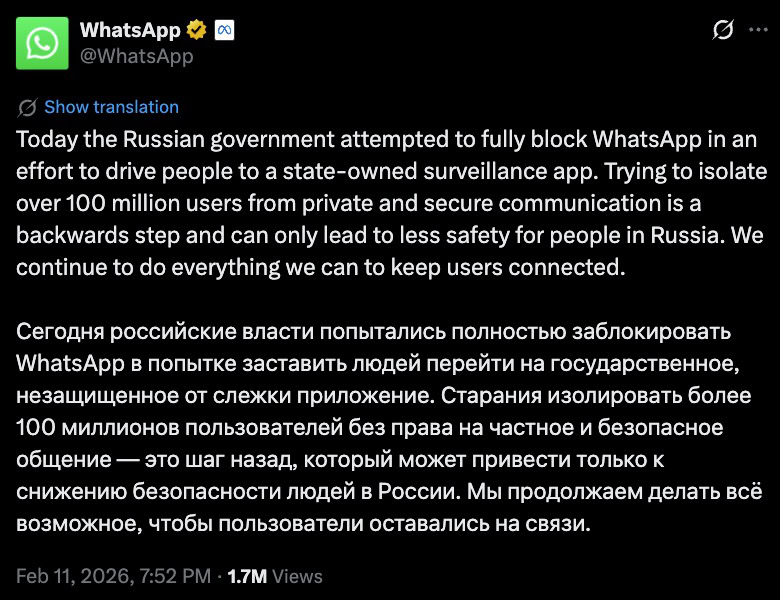
WhatsApp responded directly: “Today the Russian government has attempted to fully block WhatsApp in an effort to drive users to a state-owned surveillance app. Trying to isolate over 100mn people from private and secure communication is a backwards step and can only lead to less safety for people in Russia.”
The same regulatory tool has already been applied to other Meta platforms. Facebook and Instagram were designated “extremist” and removed from the registry, leaving them largely accessible only through VPN services. YouTube has also experienced visible degradation, according to Russian internet analysts, though it remains uncertain whether it has been fully erased from the directory.
Each of these actions leaves a paper trail. Registry updates, bandwidth throttling orders, and technical directives to providers collectively reconfigure the digital environment without a single dramatic announcement.
The wider agenda behind all of this is likely Max, an app promoted by the Kremlin as the country’s “national messenger.”
Modelled partly on China’s WeChat, Max combines messaging with access to state services.
It does not offer end-to-end encryption, so messages can be read by whoever has access to the servers. The application is owned by VK, Russia’s largest social network, which, these days, is controlled by figures close to President Vladimir Putin.
Official designation last year gave Max privileged status, integrating it into public services and encouraging migration from foreign competitors.
As we reported this week, Telegram, which is more popular in Russia than WhatsApp for news and entertainment, has also faced renewed disruption. Pavel Durov, the Russia-born founder of Telegram, addressed the restrictions in a public message: “restricting citizens’ freedom is never the right answer.
“Telegram stands for freedom of speech and privacy, no matter the pressure,” he wrote on the messaging service.
The measures form a coherent administrative strategy. By altering registry listings and constraining bandwidth, regulators determine which communication tools remain reliable inside Russia. As encrypted platforms are pushed to the margins, users are channelled toward services embedded within the state’s legal and technical framework.
The consequences extend beyond a single app. When access to private, end-to-end encrypted messaging is curtailed at the infrastructure level, the space for confidential exchange contracts.