As Uganda moves toward its January 15 general election, the country has once again entered an information lockdown.
Despite repeated assurances from officials that the internet would remain open, access vanished across much of the country on Tuesday.
The order, confirmed by network analytics firm NetBlocks, cut off millions of Ugandans from social media, messaging platforms, and even some international phone lines.
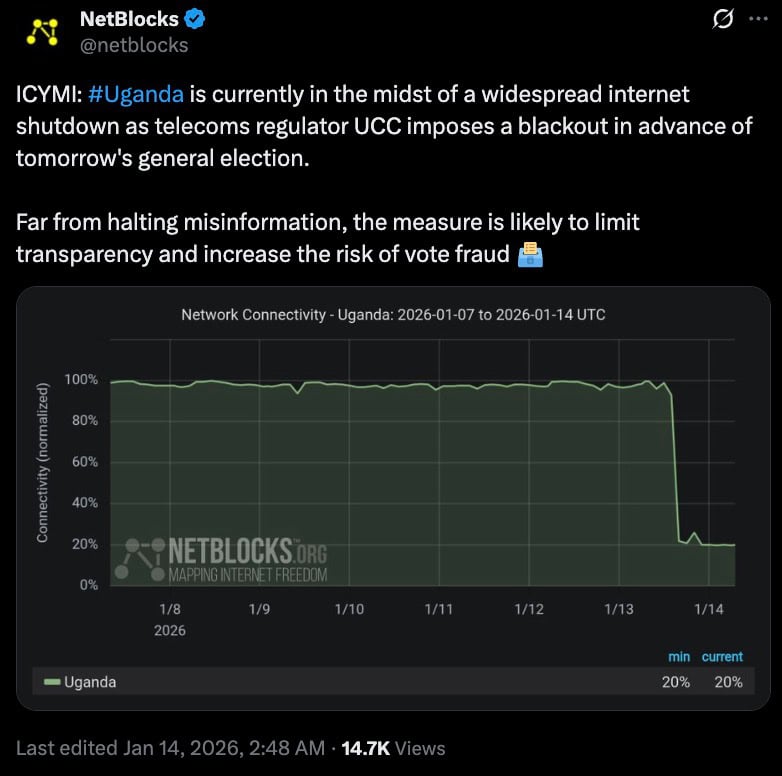
Authorities justified the move as an effort to contain “misinformation” and “electoral fraud.”
The blackout arrived after weeks of denials. Uganda Communications Commission (UCC) head Nyombi Thembo told Capital FM that “as of now, there is no resolution to switch off the internet,” while the Permanent Secretary of the ICT Ministry, Amina Zawedde, said, “Government has not announced, directed, or implemented any decision to shut down the internet during the election period.”
Both accused journalists of spreading “false and misleading” claims. Their statements now stand in direct conflict with the current reality.
President Yoweri Museveni, in power since 1986, faces off against opposition leader Robert Kyagulanyi, widely known as Bobi Wine.
The campaign has unfolded under tight surveillance and a growing list of prohibitions. Public gatherings have been banned, journalists have been detained, and independent election monitors have been ordered to suspend their work.
The United Nations Human Rights Office said on Friday that Uganda’s vote is taking place “in an atmosphere of repression and intimidation.”
Security forces, according to the UN, have used live ammunition to disperse crowds and arrest opposition supporters in the weeks leading up to the election.
Faced with an abrupt loss of digital access, Ugandans have turned to alternative channels to stay connected.
Data from Proton VPN shows two early signup waves, each more than 250 percent above normal, followed by an 8,000 percent explosion in signups within the first hour of the shutdown.
The company’s app leapt from position 24 in Uganda’s App Store on December 16, 2025, to number 2 by January 14, 2026.
The messaging platform Bitchat also became a lifeline. Its App Store ranking in Uganda shot from 27 to 1 between mid-December and the end of the month and has remained in the top spot ever since.
Sensor Tower data shows that Bitchat hit the number one position on Google Play on December 31, 2026, after climbing from rank 16 just two weeks earlier.
Tor’s metrics show a similar rise in Ugandan users, suggesting many have moved to privacy networks to bypass state filters.
The decision by Starlink to disable service in Uganda after a regulatory directive added another obstacle for those seeking alternative connections.
That move has drawn comparisons to the 2021 election, when authorities cut access for four days, and at least dozens were killed in street protests.
While the government claims these restrictions are meant to safeguard public order, the timing suggests a deeper concern about visibility.
Internet shutdowns during elections silence the very people who might document abuses, share live results, or organize.